
The British government could learn a lot from the mistakes of HS2. In 2012, its predecessors approved this controversial high speed rail project, which promised to cut travel time between London and Birmingham, Manchester, Leeds, and York.
By 2023, construction on all but HS2’s London to Birmingham leg was cancelled due to overestimated benefits and underestimated costs. In 2013, the National Audit Office found that the government repeatedly made mistakes that inflated the project’s economic impact. Consultants used a “made up” methodology that overstated additional benefits from HS2 by 6 to 8 times. As of 2025, construction is on track to run 50 to 100% over budget and is delayed by as much as 7 years. Interrogating the data for HS2’s impact in advance might have avoided raising false hope and wasting taxpayer money.

The government risks repeating this failure if it doesn’t properly review the figures behind a new campaign to restart international rail services at Ashford. The Good Growth Foundation (GGF) reports that reopening Ashford International could generate £534 million in economic growth per year, a figure now widely cited in the media and picked up as evidence by MPs representing South East constituencies. The problem is that GGF’s economic analysis, based on estimates of additional spend by foreign visitors to Kent, relies on faulty assumptions.
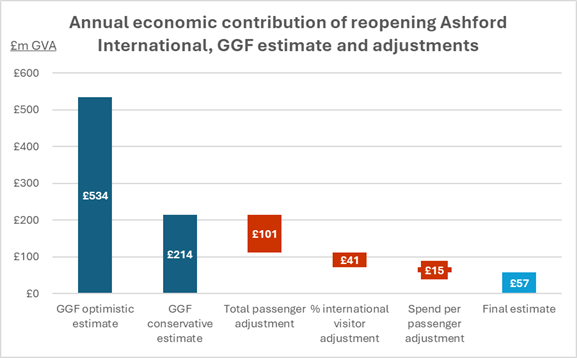
Firstly, GGF overestimates the number of Eurostar passengers who travelled to and from Ashford. GGF attributes the difference in pre- and post-pandemic Ashford passenger numbers (296,000 travellers) entirely to the loss of Eurostar services. They ignored a news report from March 2025 where Eurostar provided Ashford traffic information for 2019, the year before the pandemic. Just 1.4% of passengers travelled from Ashford out of 11.1 million Eurostar passengers that year, or around 155,400 total travellers.
GGF then incorrectly calculates the proportion of passengers that travel to Ashford from overseas. GGF uses the percentage of Eurostar’s inbound services to total services on the Ashford/Paris route as a proxy for international traffic. Setting aside whether this methodology is valid, GGF overcounted the number of services, as some did not run every day and timetables changed partway through the seasonal schedule. Their estimate that 66.7% of travellers are from overseas is based on counting 3 outbound and 6 inbound train times, when the weighted average number of services per day at Ashford was 1.8 outbound and 2 inbound in 2019[1], or 52.8% inbound. However, schedules are not the best way to measure point of origin, as they ignore occupancy levels. A more direct measure is the proportion of international travellers using the Channel Tunnel. The Office of National Statistics (ONS) provides this data for 2019 and 2024, at 40.0% and 42.4% respectively[2].
GGF also uses inaccurate data for international visitor expenditure in Kent. Figures sourced from VisitKent of £639 per international visitor are averaged across South East England in 2022. ONS provides more specific and recent data. International visitors to Kent spent £507 per visit in 2024, one fifth lower than GGF’s assumption[3].
GGF’s ‘optimistic scenario’ of £534 million in Gross Value Added (GVA), which appears in media reports and in parliament, is over 9 times higher than realistic growth estimates. This assumes that Ashford’s Eurostar demand will return to 1990s levels. Eurostar’s direct services to London St Pancras began in 2007, which contributed to Ashford services dropping from 15 daily inbounds at their 1990s peak to 4 in 2007 and just 2 before the pandemic. Given Eurostar passenger numbers in Kent grew 0% from 2009 to 2019, GGF’s optimism is difficult to defend[4]. Correcting GGF’s assumptions reduces their ‘conservative’ estimate of growth (based on 2019 traffic) from £214 million Gross Value Added (GVA) to just £57 million GVA per year, almost 90% below the original high case.
Beyond the economic impacts, GGF’s proposal for the government to fund the cost of terminal upgrades may not be sufficient to reinstate international services. Eurostar has resisted bringing back Kent routes not just because of the required investment but because demand was limited, and stopping in Kent elongates the service for London passengers. More subsidies may be needed to incentivise international rail operators to serve Ashford International.
Restarting international services might also be counter-productive for local growth. British tourists take more than twice as much money out of the domestic economy as foreigners bring in when they visit. This is one reason why the New Economics Foundation argues that UK airport expansions won’t deliver meaningful growth. In 2024, South East England residents spent 6.2 times as much in Europe as European visitors to the South East, a net deficit of £6.4 billion[5]. Making it easier for Kent residents to go to Europe could widen this spending gap.
However, GGF’s political instincts are spot on. Reopening Ashford is an opportunity for the government to demonstrate that it can deliver change. Over 66,000 people signed a petition to reopen the Kent Eurostar terminals, which have been closed since 2020. If Kent locals want to use the Eurostar to travel to Europe, they must first commute to London, adding over an hour to their trip. Frustratingly, Kent residents pass by the closed Ashford terminal on their way home, unable to disembark. Restarting international services at Ashford is a short-term, visible improvement for local residents, with a relatively small cost (up to £3.5 million one-off and up to £1.4 million recurring per year).
There are good reasons to reopen Ashford International. Growth just isn’t one of them. If the government touts economic benefits that don’t materialise, voters could lose confidence in more ambitious growth proposals for energy, AI, and housing. The government needs to use accurate and fact-checked analysis on the costs and benefits of its spending, if its commitments to growth are to remain credible.
Lucy leads Gordon Management, a firm specialising in energy and infrastructure investments. In a previous investing role at Blackstone, she worked on a transaction to purchase a stake in the Channel Tunnel. She holds an MBA and an MPA from Harvard University.
[1] Using data from the winter and summer schedules for 2019.
[2] Using data for Channel Tunnel traffic, UK residents travelling abroad and foreign residents travelling to the UK. This data includes Eurostar and other operators. The most recent figure is used in the analysis corrections.
[3] Using data on spending in areas of Great Britain, foreign residents travelling to the UK
[4] GGF also erroneously calculated the optimistic case as 2.5 times the conservative case based on the ratio of 15 inbound daily services in the 1990s to 6 inbound daily services in 2019. There were actually 2 daily inbounds in 2019.
[5] Based on 2024 ONS travel statistics, UK residents travelling abroad from South East England spend £7.6 billion in Europe and foreign residents travelling to the UK from Europe spend £1.2 billion in South East England.