
Announcement: Join me live in London on January 6th, 2026 for a conversation with Earth Set on why we can’t seem to quit coal. Get your tickets here.
“If your mother was on life support, would you want coal or renewables supplying electricity to her hospital?”
A State senator for West Virginia threw this curveball at me when we were discussing the merits of renewable power over coal. Our conversation had been a series of shifting goalposts, ranging from whether renewables were lower cost, to whether they generated more waste. When we got to the question of guaranteeing dispatchable, reliable power, he had a point [1]. Historically, using renewable energy round-the-clock and relying on it for emergencies has been either impossible or far too expensive. Low-cost batteries are changing that picture.

Before we talk about batteries, it’s worth clarifying what analysts mean when they say renewable energy is cheap – especially as energy bills have gone up around the world as renewable power has gained market share. Levelised cost of electricity, or LCOE, measures the average cost to produce each kilowatt-hour of electricity during a plant’s usable life, combining capital, financial, and operating expenses. This metric helps to compare technologies with different up-front and ongoing costs. On this measure, the unit cost of new solar and wind projects was lower than building new fossil fuel plants in 91% of utility-scale installations in 2024.
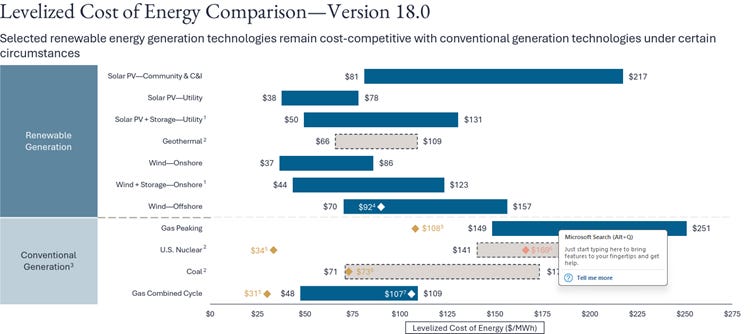
However, pundits criticise this measure because it does not reflect the interconnected costs of the whole system. Renewable energy is not always available when customers want to use electricity so alternative power sources are needed when renewable energy isn’t generating. This can raise the price of coal and gas power if operators seek to recover more of their fixed costs in the hours of the day when they are required. Turning on and off to match demand increases fatigue in coal plants, raising maintenance costs. Transmission and distribution system costs can also go up from renewable energy installations, partly from managing instability in the system, and more sites requiring grid connections in areas that may not be near demand centres.
Thanks to a sharp drop in battery costs, availability critiques are becoming outdated. Ember reckons that “dispatchable solar” is now competitive with fossil fuel generation. Based on data from recent battery projects (outside of the US and China), lower capital costs and improvements in operating efficiency have reduced the cost of storing power to be used when it’s needed. Using another levelised calculation for the cost of storage (LCOS), Ember estimates each stored unit costs $65 per megawatt-hour. In a stylised example, if 50% of solar generation is shifted to non-sunny hours, this adds $33 per megawatt-hour to the average cost of all electricity from that facility [2]. With global average solar prices at ~$43 per megawatt-hour, a solar and storage solution looks competitive with coal and gas at $73 and $85 per megawatt-hour respectively.
Ember stresses that this does not mean solar and batteries offer fully “baseload” power, i.e. reliable, 24/7 availability. But is this the right goal?
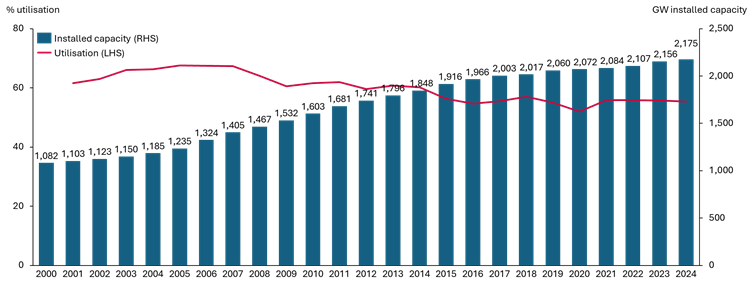
Electricity demand is not flat throughout the day, and coal isn’t used around the clock. The average utilisation of coal plants globally is just 55% as of 2024, calculated using Ember data. Even in China, the world’s poster child for coal power, average utilisation was ~57%, with variability depending on the season [3]. Utilisation could decline dramatically with the rise of renewables and Centre for Research on Energy and Clean Air researchers anticipate coal’s role could shift to back-up generation with the right policies in place.
Baseload generators alone are no guarantee of grid reliability. In Australia, for a 6-month period this year, analysed by Reliability Watch, coal power plants were down 22% of the time. Two thirds of that downtime was unplanned. In West Virginia, a coal-heavy grid was disrupted by a deadly hurricane in the week before I visited, leaving 92,000 customers without electricity. Whether coal or clean, utility-scale generation can’t provide electricity when the network is down. A grid that incorporated interconnected, distributed infrastructure like electric vehicles (EVs) or batteries would offer back-up generation in such situations and can be used or monetised when they are not needed. Instead, some people were without power for a week or more.
Flexible technologies also make baseload less relevant. Some power demand can increase or decrease according to the supply available to the system. Something as simple as controlling when hot water heating systems turn on could unleash 22 gigawatts of flexible capacity in Australia while reducing energy bills. Electric Vehicles (EVs) can be charged whenever electricity is cheapest without affecting the customer experience and eventually could provide hundreds of gigawatt-hours of distributed back-up storage to the grid. Illustratively, with EV market penetration at just 5% of cars, British EVs contain enough batteries to power the equivalent of the UK’s electricity demand for a couple of hours [4].
Even so, there is still requirement for back-up power when renewable energy cannot deliver. Getting close to 100% availability requires over-sizing installations to accommodate extreme weather events, reducing the cost advantage of renewable energy. Coal and gas power are perceived as the last backstops for delivering reliable capacity, able to run at 95 to 100% load for as long as they have access to fuel. These could be kept as back-up only systems, only turning on when absolutely needed and thus saving on carbon emissions, if they can be compensated for their reliability value independently from energy delivery.
A landmark renewable energy project in the Democratic Republic of Congo could prove that renewable energy can deliver back-up power too, at 95% uptime and saving money compared to fossil fuel solutions. CrossBoundary’s first-of-its-kind solar and storage project, serving the Kamoa-Kakula copper mine, plans to deliver 30 megawatts of dispatchable power with a 95% availability guarantee. This is intended to displace more expensive diesel back-up power, a necessary cost of doing business in a country with a notoriously unreliable grid.
There’s one catch: it’s astonishingly large.
This project illustrates the trade-off of oversizing systems for extreme weather. CrossBoundary will install 233 megawatts of solar power and 532 Megawatt-hours of batteries across 150 hectares of land. Peak generation capacity is 7.8 times the expected load and batteries store up to 17.5 hours of energy at the contracted output.
These numbers aren’t so big after considering the availability of solar energy. DRC’s average daily practical potential is 4.3 megawatt-hours per megawatt on average, which means that the facility can generate just shy of 1,000 megawatt-hours per day. Spread across 24 hours, this would be around 41 megawatts. This back-of-the-envelope calculation makes guaranteeing 30 megawatts at 95% uptime seem reasonable, especially after accounting for system losses and seasonal variation [5].
Solar and batteries might be cost-effective compared to diesel gensets as back-up power, but can they work on a large national grid? India, the world’s second largest coal consumer, now has solar plus storage projects contracting in round-the-clock auctions at competitive prices. UC Berkeley researchers found that based on the cost of storage at these auctions, solar and storage could deliver 95% availability more cheaply than building new coal or honouring some states’ existing industrial tariffs, at less than 6 rupees per kilowatt-hour (~$66 per megawatt-hour). This is an underrated achievement, considering that India is still powering ahead with new coal facilities.
Transitioning to a low carbon energy system still has technical challenges. Relying on any one energy source is a risk, especially as weather events are correlated across facilities. A diversified system with redundancy is a more resilient one. Coal and gas could be reframed as a backstop energy provider instead of the default. There may be times of the day when fossil fuels are always on, for example 6 to 8am before sunrise and after batteries have run out, but this would still represent a dramatic shift in carbon emissions. This might require alternative market designs that reward reliability, like capacity markets, rather than just paying generators for the energy they supply.
The goalposts will inevitably keep shifting for renewables while the coal and gas industries fight to stay in business. Land availability is a potential constraint, which could be alleviated by re-purposing brownfield land and co-locating solar panels with agricultural and other uses. Protecting local jobs and reducing import dependence are worthy goals, but governments should make it clear that this is a trade-off that could increase the cost of electricity. Arguments against renewables would be altogether less salient if more countries incorporated carbon prices and health impacts into the cost of energy.
As for what kind of energy I would trust for my mother’s life support, I think our grids should have a diverse mix that balances cost and sustainability. Hospitals and other essential infrastructure should and do have their own back-up generation so that resiliency isn’t just the responsibility of the grid. Storage is now a cost-effective complement to cheap renewable power, even before adding carbon prices. Diversity of supply, back-up fossil fuel generation, flexible loads, and distributed technology can all be options to manage extreme conditions and lower system costs. As solar and batteries get cheaper and more reliable, the goalposts against them will continue to shift. Soon there won’t be much field left for coal to play on.
[1] Though on the specific example, hospitals and other critical infrastructure also typically use diesel generators in the case of grid blackouts, so the reliability of the grid is less of an issue.
[2] Or, cheap solar in the day-time and more expensive power at night-time.
[3] This is based on author’s calculations of monthly Ember data for coal electricity production and average coal capacity over each month. May 2024 had lowest utilisation at 49% while August had the highest at 66%.
[4] 1.75 million fully electric cars on the road as of November 2025, with at 20 to 60 kWh battery storage is a potential total storage capacity of 35 to 105 GWh. With peak demand of 47 GW in the UK, EVs could theoretically provide power for up to a couple of hours. In practice it is more complicated – these figures are just to illustrate scale.
[5] According to the Global Solar Atlas, the lowest month of the year has ~9% practical daily potential than the annual average. The 10th percentile is ~6.5% lower than the average and the minimum long-term daily potential is ~20% lower than the average.
Thanks Lucy - a sharp software update for me re: coal and solar’s relative reliability.
I agree that the future is hybrid. I’m curious if different energy players will be jostling to be the ‘main source’ for energy grids, or if there will be a conglomeration that uses both coal and solar - selling the outcome of 24/7 power regardless of where it comes from.
As the earth’s sky, we may become our stars rising, by recognizing that to move for the coequal station, is to move forth with and for everyone, as the~shielded~shield~of~Nature.
That we may be the Truth of our Humanitee, together becoming an Earth Rising.
https://open.substack.com/pub/republia/p/for-the-preservation-of-freedom-and?r=4ucf6d&utm_medium=ios&shareImageVariant=overlay