
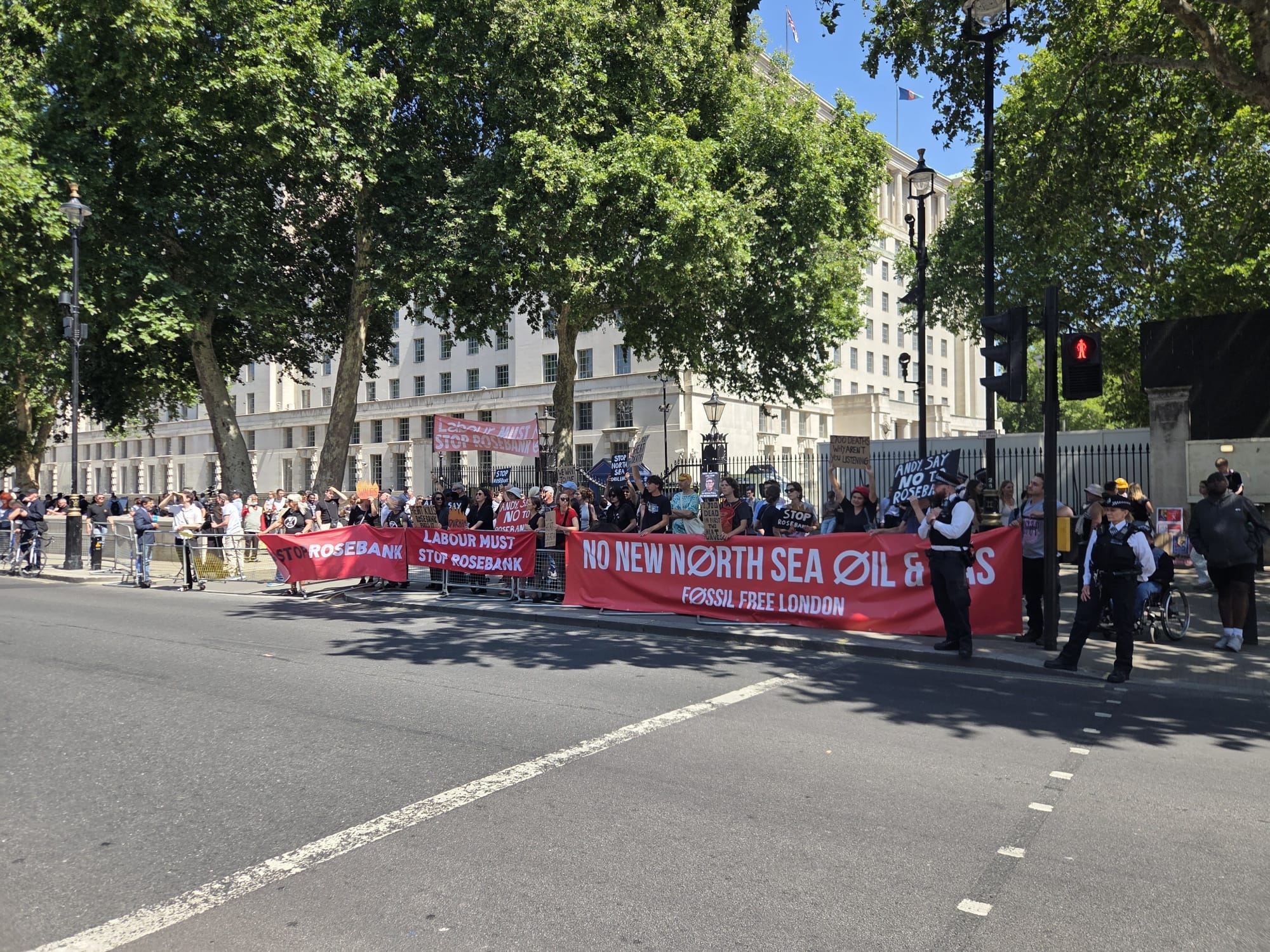
If you saw a British newspaper over the summer, you would think the Jackdaw and Rosebank oil and gas developments in the North Sea were existential for either the environment or the economy. On both sides, the symbolism of whether the government decides to let these projects proceed is far larger than the direct impact. But approving or denying the projects alone will not be enough to win over either camp. The rest of the government’s agenda is about the growth and the cost of living. On this, it stands more to gain from a consistent approach to climate action than preservation of the North Sea oil industry.
Why this is an issue now
Rosebank and Jackdaw are previously consented oil and gas developments that became a political issue for the Labour government because these consents were illegally awarded. The previous government were required to consider the downstream carbon emissions produced by the projects in their approval process. They did not do this, even though it may not have changed the outcome of their decision. Consultations on the revised application concluded last month and the government is under pressure from all sides to make a swift decision.
An approval process based on costs and benefits (i.e., not ‘vibes’) rests on whether jobs, taxes, foreign exchange, and security upsides outweigh the environmental impact in the UK and elsewhere. The “pragmatic” consensus is coalescing around approving Jackdaw and rejecting Rosebank. Rosebank and Jackdaw have been lumped together in the public debate, and indeed have the same sponsor1, but Rosebank’s primary asset is oil, while Jackdaw’s is gas. This distinction matters for the counterfactual scenario of the government’s decision.
What’s driving rumours of Jackdaw approval
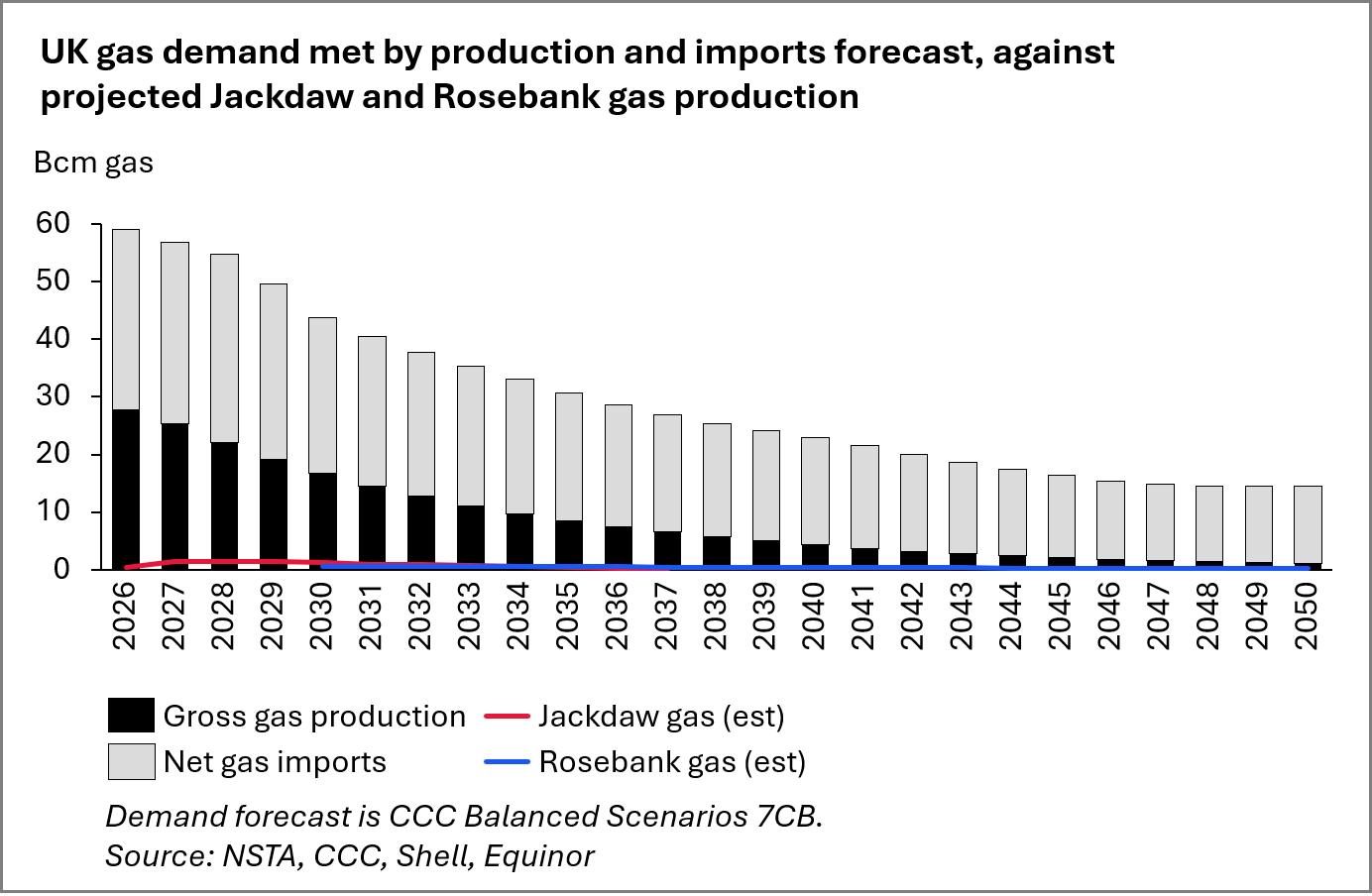
The UK is going to use at least its own domestic gas supply for the lifetime of Jackdaw’s production, so the case for approval is prioritising British industry and import substitution. Jackdaw could produce just under 3% of the UK’s gas demand at peak and would stop producing after around 10 years2. The UK currently imports 49% of its gas across power and heating3 and UK energy demand forecasts suggest we will be importing gas for consumption for at least the next two decades, regardless of whether Jackdaw is approved. Since none of the capacity would be reserved for British consumption, Jackdaw wouldn’t particularly help with energy security unless the government restricted exports in a future supply crunch.
Jackdaw and Rosebank provide less gas than forecast consumption, likely substituting for imports
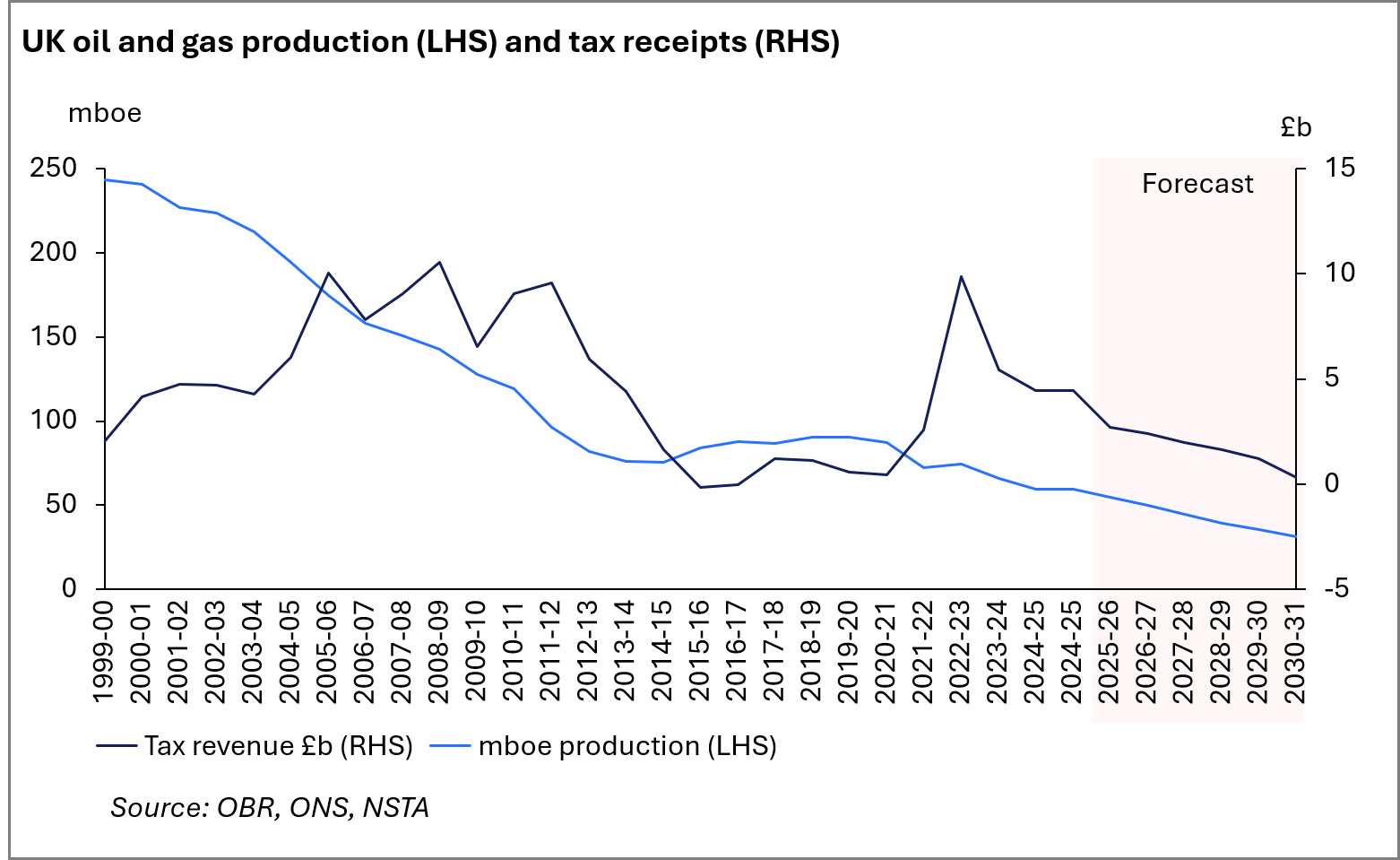
Jackdaw is otherwise no economic saviour for the UK or even the North Sea. Its foreign exchange impact could be up to £1 billion at current elevated gas prices4 but more likely much less, making a small dent in the £60-odd billion annualised trade deficit. Its tax contribution would be modest, given the entire oil and gas industry is expected to generate just £0.1 billion in tax receipts by 2030/31 due to the phaseout of the Energy Profits Levy. Even with the introduction of the replacement Oil and Gas Price Mechanism (OGPM), which collects 35% of revenue above gas prices of 90p per therm, Jackdaw would generate hundreds of millions of pounds if prices remain elevated above pre-Iran War levels. This is a small consolation for the economic fallout of high gas prices. Its employment benefits are tiny, creating 27 new jobs over its decade-long project life while “supporting” 273 on its host platform5. The oil and gas industry employed 115,000 people as of 2024.
Neither would approving Jackdaw be a climate disaster compared to its counterfactual. At peak production, Jackdaw’s emissions across gas and liquid products represent 1.5% of the 2025 UK total6, but the UK is very likely to use this gas in the next decade regardless of its source. Import substitution saves 15% of emissions if Jackdaw replaces Liquefied Natural Gas (LNG) and adds 5% to emissions if displacing Norwegian supply7. It wouldn’t increase demand unless it reduced prices, and Jackdaw is probably too small to influence markets. If the climate impact is truly neutral and there minor economic benefits, rejecting Jackdaw is a signal more than substance.
Why Rosebank is more likely to be rejected
Rosebank is more complicated. It would increase UK oil production by ~10% and could even supply 2% of the UK’s gas demand8. Rosebank’s oil would not contribute directly to the UK’s energy security as it would be exported for refining elsewhere. This is not unusual: over 80% of the UK’s crude oil production is exported, while almost 90% of domestic crude demand is served by imports9. It creates 450 long-term and 1,600 construction jobs, significantly more than Jackdaw but not exactly rescuing North Sea oil employment. At current prices, Rosebank would generate up to £2.2 billion in foreign exchange receipts10 across oil and gas11. This may not translate into much extra tax under OPGM as oil prices are currently only slightly above the new tax threshold, and oil represents most of Rosebank’s production value.
Oil production decline levelled out when taxes were cut, with low revenue forecasts to 2031
But it is more likely to be rejected on climate grounds. Its impact on the UK’s own emissions targets is negligible as 84% of the oil emissions occur in consumption12. But Rosebank’s annual contribution to carbon emissions represents 2.7% of the UK’s 2025 total13, more than Mozambique or Cameroon. If Rosebank’s production adds to global demand rather than displacing another supplier, it would have a significant negative impact on climate even if not the UK’s own carbon budget.
Notably, the cost-of-living argument has fallen away. Both projects produce globally traded commodities, and neither would supply enough energy relative to the total market to materially reduce average prices. Jackdaw’s peak production would represent about 0.4% of the UK and Europe’s connected demand14, while Rosebank’s represents 0.1% of global crude15. The government could make price caps or domestic supply guarantees a condition of its approval, but this would effectively be a fossil fuel subsidy. The OGPM tax allows the government more discretion over how it uses extra revenue from high energy prices.
This decision isn’t the real climate and transition story
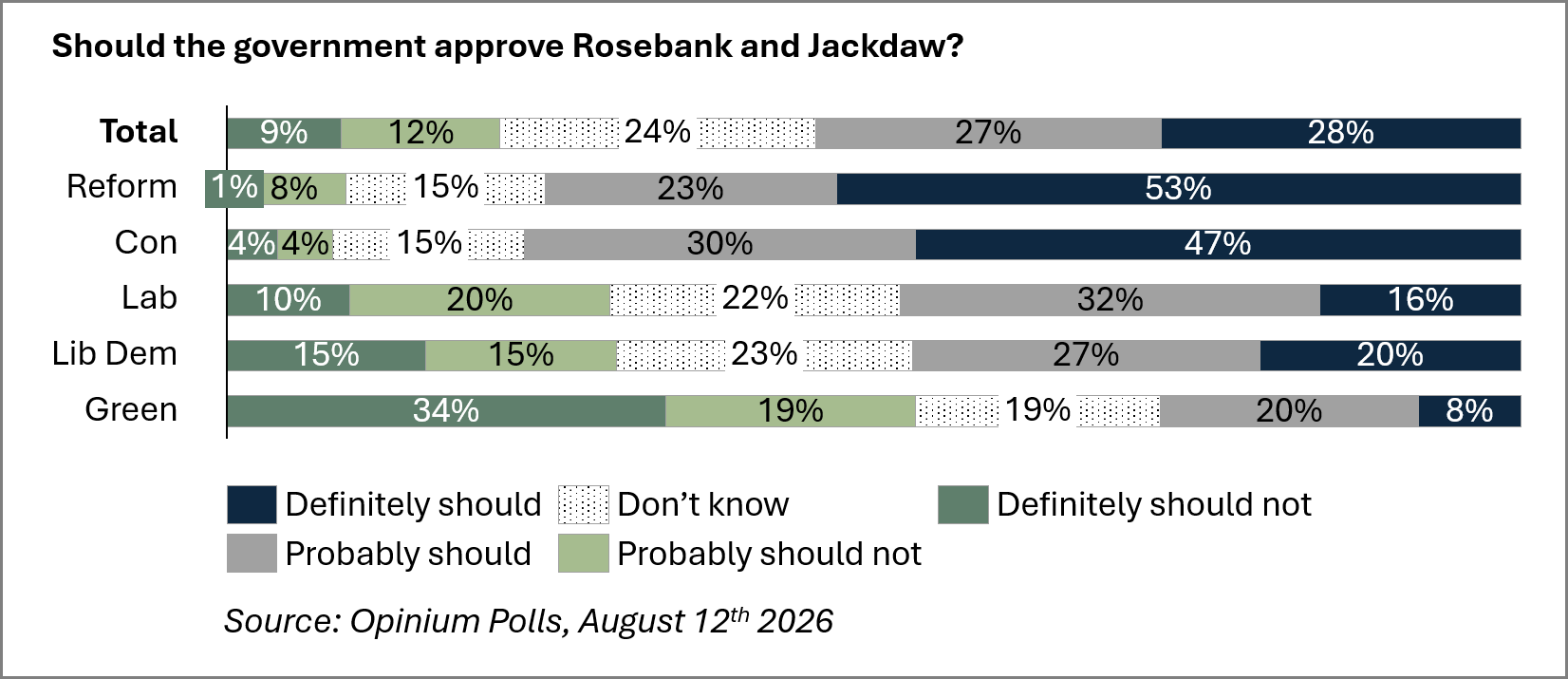
The outsized coverage of the Jackdaw and Rosebank decisions reflect that oil and gas policy is about symbolism and solidarity, not just a cold cost-benefit analysis. There are just a few hundred jobs at stake and only a modest economic benefit, while over 60% of voters support net zero. But half of the electorate thinks the government should approve Rosebank and Jackdaw according to Opinium polling, and even 28% to 48% of Labour, Liberal Democrats, and Greens voters. Some of the reasons cited across other polls are energy security, economic benefit, and jobs.
Even 28% of Greens voters support Rosebank and Jackdaw approvals
Pleasing the climate-conscious voter might still be more pragmatic. Either way, the new Prime Minister Andy Burnham’s decision is going to put people off. While both major rightwing parties, Conservatives and Reform, are united in opposing climate action, Burnham can offer a credible pro-net zero alternative that could persuade moderates and keep his climate-conscious supporters from turning to the Greens.
There’s also a lot more economic growth and cost of living potential in pro-climate action than sustaining the oil industry. Jobs in the UK’s oil industry generally are about a third as big as the low carbon economy (304,000 in 2024) and the sector faces structural decline even if Jackdaw and Rosebank proceed. Prolonging a transition instead of planning for what’s next risks letting down oil and gas workers “the way miners were let down” decades ago. Renewables deployment reduces dependence on volatile oil and gas prices, and these technologies help households save on bills.
Even if Burnham rejected both projects, very little would change with respect to Britain’s climate impact without further action. Jackdaw’s gas demand represents around 3.3 million heat pump conversions16 but just 52,000 retrofits are being installed a year. Personally attending COP31 in Turkey is a start, especially after the UK’s summer of heatwaves, but the government should also double down on electrifying heat and transport demand to fully realise the potential for emissions reduction and addressing the cost of living. Subsidies for heat pumps and EVs certainly help, but there’s more that can be done to shape incentives.
Electrifying heat and transport would do more to move the needle on climate
The single biggest thing the government could do to accelerate uptake of electric heating is reduce the ratio of electricity to gas prices. This could be achieved by equalising levies and carbon taxes across household gas and electricity. Implicit carbon taxes from heat pump subsidies are in the order of £200 per tonne for a £7,500 boiler upgrade grant17, while electricity faces a carbon price of £50 per tonne18 under the UK Emissions Trading Scheme. Household gas is not carbon taxed at all. Applying a similar carbon cost to domestic gas whether directly or via levy reform would increase its price by 0.9p per kilowatt-hour19, in turn reducing the ratio of gas to electricity prices from 3.3 to 3.0 under the Q4 price cap. This saving, plus potentially eliminating £108 in gas standing charges by disconnecting from supply, would incentivise investments in electric heating so that running costs are lower if switching from gas. To alleviate distributional impacts for those who cannot upgrade quickly, like renters or homeowners with low income, proceeds from the tax could be returned to households as lump-sum payments.
Housing and planning reforms are another Treasury-neutral intervention. Most new builds still have gas boilers, less than two years out from full implementation of the Future Homes Standard, and retrofits have even less uptake. Local government planning approvals are a constraint for heat pump adoption, particularly for people in apartment buildings, and financing new heat pumps is also a challenge for landlords and homeowners even with generous government grants. Automatically authorising heat pump planning approval, as is done for solar panel installations20, would reduce installation friction, as would reducing policy barriers to investment products that finance heat pump installation21.
On transport, the electric vehicle (EV) switch is well underway, and is already effective for reducing car costs. The government should resist pressure to water down its Zero Emissions Vehicle (ZEV) mandate for car manufacturers, which currently requires 80% of sales to be zero emissions by 2030 and all sales by 2035. Making public EV charging cheaper by supporting flexible energy procurement, standing charge reductions, and reduced planning burdens could boost adoption for car-owners who park on the street, around 25% of all cars in England.
The decision
Burnham could compromise by approving both Jackdaw and Rosebank while doing everything in his power to reduce British oil and gas demand. The government has no obligation to ensure there will be buyers for their supply since private investors bear the risk of these oilfields’ success22. The government could even negotiate supply guarantees or price caps to strengthen energy security and cost-of-living benefits.
But vibes matter for this decision. The compromise approach above negates the good news story of supporting oil and gas workers, and puts climate-conscious voters offside.
The cleaner and pragmatic political option is to take climate action seriously and link it with cost reduction, rejecting Rosebank and possibly even Jackdaw while blitzing the deployment of clean technologies. This provides clarity for the oil and gas industry and its workforce, so that they can plan and access support. Labour would also retain its status as the only credible pro-net zero party that can deliver. Above all, this helps Burnham and his new government make the case for how energy policy will improve economic stability and drive down the cost of living.
Join over 1,100 followers and 800 subscribers in 60 countries by subscribing for more updates and analysis on the energy transition. Leave a comment or reply to this email with your thoughts.
Both projects are majority owned by Adura, a Joint Venture with Shell and Equinor. Ithaca has a 20% minority stake in Rosebank.
Using the North Sea Transition Authority figures which in turn use CCC Balanced Pathway forecasts and Shell’s Jackdaw Emissions Assessment Appendix A and B.
Assuming 1:1 import substitution, current elevated gas prices of 180p/therm, 1.45bcm peak production (Shell) and 379 therms per bcm (NSTA)
Depending on which is the swing supply. It is not always LNG. Carbon Brief, 2026.
Imputed from filings. Rosebank Emissions Assessment Tables 16 and 17.
Exports and import substitution
Using 2025 current prices, ~180p per therm for gas, ~$92 per bbl for oil, and 2030 production imputed from the Rosebank Emissions Assessment Tables 16 and 17.
Estimate from the Rosebank Emissions Assessment, proportion of emissions well-to-tank.
Total contribution of 249 million tonnes of CO2 divided by 25 years of production life. Rosebank Emissions Assessment.
1.8 tonnes of emissions savings compared to peak emissions of 5.7 million tonnes in 2027 (Shell).
Based on 1,830 kg of emissions savings per year for 20 years, for the average home.
Based on civil penalty price of £49 for 2026.
Via Permitted Development Rights - Conservation Areas are a notable exception.
E.g., landlords breaking rules or inadvertently needing heat network authorisation if they finance heat pump installations and share in the cost savings with tenants.
In practice they may seek further tax breaks or government support if the projects perform poorly.
I agree that the signalling is more important than the implications for emissions or the treasury. But I think the signalling should be about doing the best the government can to rebuild consensus and to keep the UK's climate policy in step with public opinion which is largely supportive. On that basis I would approve both.