
¿Por qué no los dos? (why not both?) settled the debate between hard- and soft-shell tacos. Applying this logic to electric vehicles (EVs) policy is less helpful. The UK government is floating the idea to tax EV mileage when it only just launched subsidies for upfront costs. Doing both at once is fiscally inconsistent, and confuses voters on the purpose of motoring taxes and EV incentives. The government instead has an opportunity to re-design a fairer system for how drivers contribute to public finances.
EVs were initially supported to reduce the environmental impact of driving, even if they were more expensive. As the UK’s energy system became increasingly decarbonised, transport became the dominant source of UK carbon emissions. To meet climate goals, the government supported EV adoption through incentives (e.g. grants for cars and chargers, registration fee discounts, tax breaks on company cars, funds to build charging infrastructure) and deterrents (e.g. congestion charges, phase-out dates, penalties for missing EV sales targets). This combination of factors, along with innovation in places like China, has helped to grow fully electric cars to 22% of new car sales and 5% of total cars on the road as of October 2025[1]. Including plug-in hybrids, these figures are 33% and 8% respectively.
Although EVs are more expensive than petrol cars on average, many EV models are now cost-competitive with new petrol cars. Charging EVs is also cheaper than running a petrol car, even with the UK’s high consumer electricity prices. The government advises that the fuel for petrol cars costs 12p to 14p per mile on average. EVs cost just 7p to 8p per mile if charged at home, or as low as 2p per mile[2] if customers sign up to special EV tariffs.
These compelling economics raise the question of how much further to subsidise EVs. They are still far from being the dominant consumer choice, so continuing to subsidise them is one way to motivate sales. The government introduced a new grant earlier this year of up to £3,750 per vehicle with a £650 million budget allocation. This was effective at driving demand, with September recording the highest EV registrations in a single month[3].
Yet subsidising EVs with cash grants sends the signal that they are not the cost-competitive option and does little to address other barriers to adoption. It interferes with re-sale value for EVs, affecting those who have already purchased them. It also creates volatility in the financing market as accurate residual value estimates are a key component of offering a competitive car loan. The government’s latest EV subsidy was also protectionist, excluding popular models from China on environmental grounds even though they would still save carbon emissions from petrol because of the UK’s low-emissions electricity grid. This subsidy could instead have been directed to other investments, like public charging, so that drivers are not charged excessively if they are unable to power up their car at home.
Meanwhile the government is rolling back some other EV incentives like discounted registration and exemptions from congestion charges. EV owners will now be expected to pay at least £195 of road tax per annum after their initial registration year. From next year, EVs will pay Central London’s £18 per day congestion charge along with everyone else[4].
The government may go even further in the budget later this month with a proposal to introduce a 3p-per-mile charge on EVs. This is to help to rebalance falling revenue from fuel taxes collected from petrol sales, which have decreased by 11% since COVID. This has caused outcry from the EV industry because it could disincentivise EV uptake at a time when the sector is nascent.
At the heart of this debate are two misunderstandings on the purpose of vehicle taxes: what these taxes actually fund and what is actually being taxed.
Fuel duty and Vehicle Excise Duty (often called “road tax”) contribute around 2.7% of government revenue, at £24 billion and £9 billion respectively for 2025/26 or £1,170 per household. This tax is perceived as funding road use. In reality, Britain only spent £13 billion on roads in 2024/25. Churchill once called road tax the “raid fund” because it was so often used to support spending in other parts of the economy.
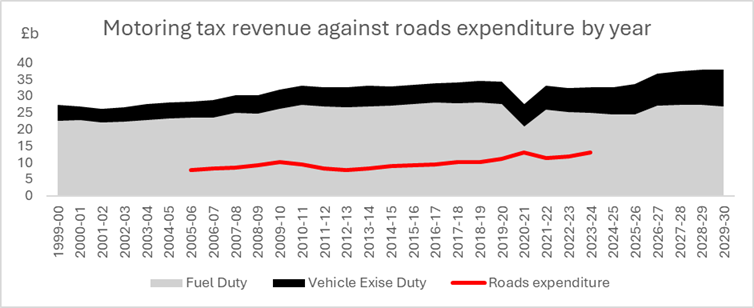
The rise of EVs has eroded a portion of this revenue base from road tax exemptions and no fuel charges. The call for EV drivers to pay their fair share for using the road is important not only for funding infrastructure but for the general government budget. But fewer fuel-consuming vehicles alone cannot fully explain the drop in tax receipts.
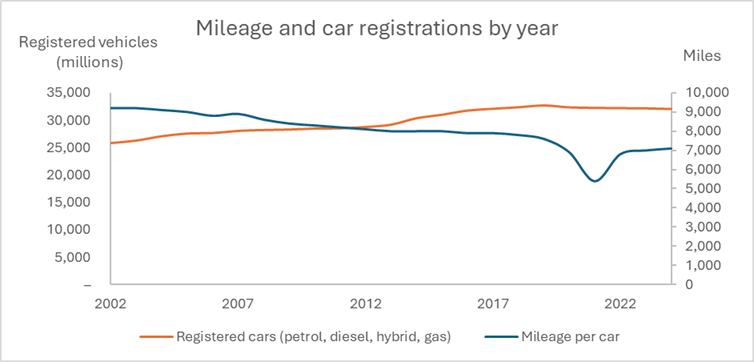
People are also driving less. Average mileage for petrol cars is 6,200 miles per year, down 3% since COVID and 25% over the past 20 years. Diesel mileage declines are even more dramatic at 13% and 38% respectively.
It’s unclear why British society believes drivers should disproportionately shoulder taxes. What is clear is that fewer vehicles paying tax, and less mileage per vehicle is contributing to a widening budget gap that drivers once reliably filled.
The perception of the UK’s fuel duty has been further complicated by its confusion with carbon pricing. This duty has supported general government revenue for decades yet exempting EVs from this payment has been perceived as a reward for going green. When polled on introducing a new mileage tax, 28% of survey respondents felt EV drivers should pay less because of their lower emissions. The UK’s current fuel duty, which is £0.5295 per litre, translates to around 5 to 9p per mile. The 3p-per-mile charge to EVs is cheaper than the fuel duty. If attributing the per-mile difference to a carbon price, this would imply a price of between £76 to £135 per tonne[5]. This is significantly higher than the current UK Emissions Trading Scheme price (over £50 per tonne), which only applies to electricity generation and some air transport.
The EV mileage proposal creates a more complicated system where EVs pay for road use differently from other drivers. It also does not set an explicit price for carbon emissions the way other sectors have established, which limits the price signals available to innovators to drive down costs from emissions savings. Given EVs are becoming cost effective and could erode an important tax base, it seems fair to re-balance taxes on their use. What seems strange is to do so at the same time as offering cash subsidies for purchases.
The government could use this opportunity to simplify, rather than complicate, how it taxes driving.
The current vehicle tax system is a mix of emissions reduction and income generation. If what the government care about is reducing carbon emissions, then it should price them consistently and explicitly. This could mean incorporating diesel and petrol consumption into the UK’s Emissions Trading Scheme. More funds could be committed to address other barriers to EV adoption, like the availability of affordable public charging and ensuring that chargepoints are kept in good repair. If the government also cares about fair revenue-raising, the government could replace fuel duties and VED with a technology-neutral system of fixed and usage-based charges for all vehicles.
Inconsistent EV measures are an illustration of Britain’s complicated tax system. Governments are understandably trying to achieve many objectives but taking from one hand while giving with the other causes confusion. We should stop pretending that fuel and vehicle excise duties are to fund roads or tackle climate change when they are effectively general taxes. Incorporating a carbon price while scrapping hand-outs for an increasingly cost-competitive technology would send a clear signal on how the government sees EVs contributing to emissions reduction. It also helps Reeves meet her budget goals, as does re-balancing motoring taxes so that all drivers pay. If the government is going for fairness with the rest of its budget, it should pick that lane on EVs too.
[1] Percent of new sales figures are year-to-date 2025.
[2] EV rates are 70% of retail tariffs. Using the government’s EV efficiency figure of 3.59 miles per kWh, EV charging on 7p/kWh tariffs costs ~2p/mile.
[3] Bumper sales are typically recorded in March and September number plates are updated to indicate the age of the vehicle.
[4] Some discounts will remain, e.g. 90% off for residents with EVs, 25% discount for EVs registered for Auto Pay.
[5] The difference between the EV per mile tax and the petrol car fuel duty tax, divided by emissions per mile. Petrol emissions are 265g per mile on average.