
Ten years ago, in the middle of the “cruellest place on earth”[i], we watched the football on a big screen under the stars. We even drank cold beer.

A small off-grid system powered a projector and a refrigerator in this village in Ethiopia’s Danakil desert. The grid had arrived elsewhere in the region, including to connect wind power back to the cities, but not at our rest stop for the night. As expensive as these off-grid installations were, people preferred to pay than wait for a connection that may never come.
Entrepreneurs in Africa have been working on the problem of slow grid build-out for years. US data centres are fast realising that the grid can’t be taken for granted. The median grid connection time for power projects in US interconnection queues was four years between 2018 and 2024, more than double the wait compared with 2000 to 2007[ii]. Just last month, Google reported data centre grid connection delays of over a decade.
To deliver compute as quickly as possible for their customers, data centre companies are increasingly taking energy supply into their own hands. Bloom Energy reported that over 70% of sites were actively contemplating co-located, or ‘behind-the-meter’ generation. Cleanview estimates that a third of data centres in the ~150-gigawatt pipeline are currently planning to develop electricity generation behind-the-meter. Building so much co-located generation doesn’t necessarily mean the data centres plan to operate off-grid or as an ‘islanded’ system. Nonetheless, Africa’s experience can offer lessons for the American data centre industry as it considers whether ditching the grid entirely would be better for its customers.
1. Speed has value worth paying for
Off-grid solar developed in Africa because so many people lacked power, and the grid was unlikely to extend to their communities any time soon. Over 600 million people lacked electricity access when I started working in Africa a decade ago – almost two entire USAs. Households who got connections didn’t spend much money on electricity, mainly because of low incomes and a lack of appliances. Although electricity connections were a vote-winner[iii], extending the grid to rural areas was often loss-making as consumption didn’t cover connection costs. Unit economics combined with limited state capacity contributed to a slow build-out of the grid, even with foreign aid.
Private companies launched to fill the gap. Diesel generators were common in rural villages and urban areas alike, to power homes and businesses during power cuts or if there was no alternative. Solar lantern companies proliferated across the continent, offering products packaged as lighting, cell-phone-charging, and TV-watching. Mini-grids offered a solution that mirrored the electricity experience of a grid at a lower cost per connection than extending the grid to sparsely populated areas, building a standalone generation source, and poles and wires. Customers in all these cases were willing to pay significantly higher rates than grid electricity, sometimes over ten times higher per kilowatt-hour[iv], because the alternative was no electricity access at all.
AI model developers also cannot wait. All else equal, cheaper electricity is better for developing AI because it lowers the cost of powering compute. But for the large AI models, losing time can be worse than paying too much for energy. Data centres used for training AI models no longer need to be sited next to where customers live to reduce latency. This in theory means that some training can be done in rural areas with cheap land and renewable energy potential, bypassing grids altogether. But for AI model developers, losing hours or days of training to electricity intermittency or a power outage is an unacceptable cost if it means their competitors can bring out their next model iteration faster.
Data centre developers and their customers will increasingly need to assess the time, cost and reliability trade-offs from their energy supply. Data centres typically have very high reliability requirements which pushes them to grid connected electricity and significant back-up power for redundancy. The trend towards behind-the-meter power is part of de-risking a late grid arrival, but ultimately still assumes the grid will get there in time as the base case. Depending on the time value trade-offs, it might be worth building completely off-grid systems that can cut years off the project’s delivery time, even if it is more expensive or less reliable.
2. Build modular and use anchor tenants
Forecasting demand for rural mini-grids was a major challenge for the African off-grid sector because many of its customers were gaining electricity access for the first time. Pre-build surveys were costly, and the results didn’t always help with successfully forecasting demand.
In response, mini-grids built modular systems, sizing system capacity based on early estimates of demand and initial sign-ups. Their technology choice of batteries and solar enabled gradual expansion. As demand grew, they augmented off-grid systems with more solar and batteries. Developers also signed up large off-takers (anchor tenants) to reduce the reliance on residential customers and even subsidise their bills.
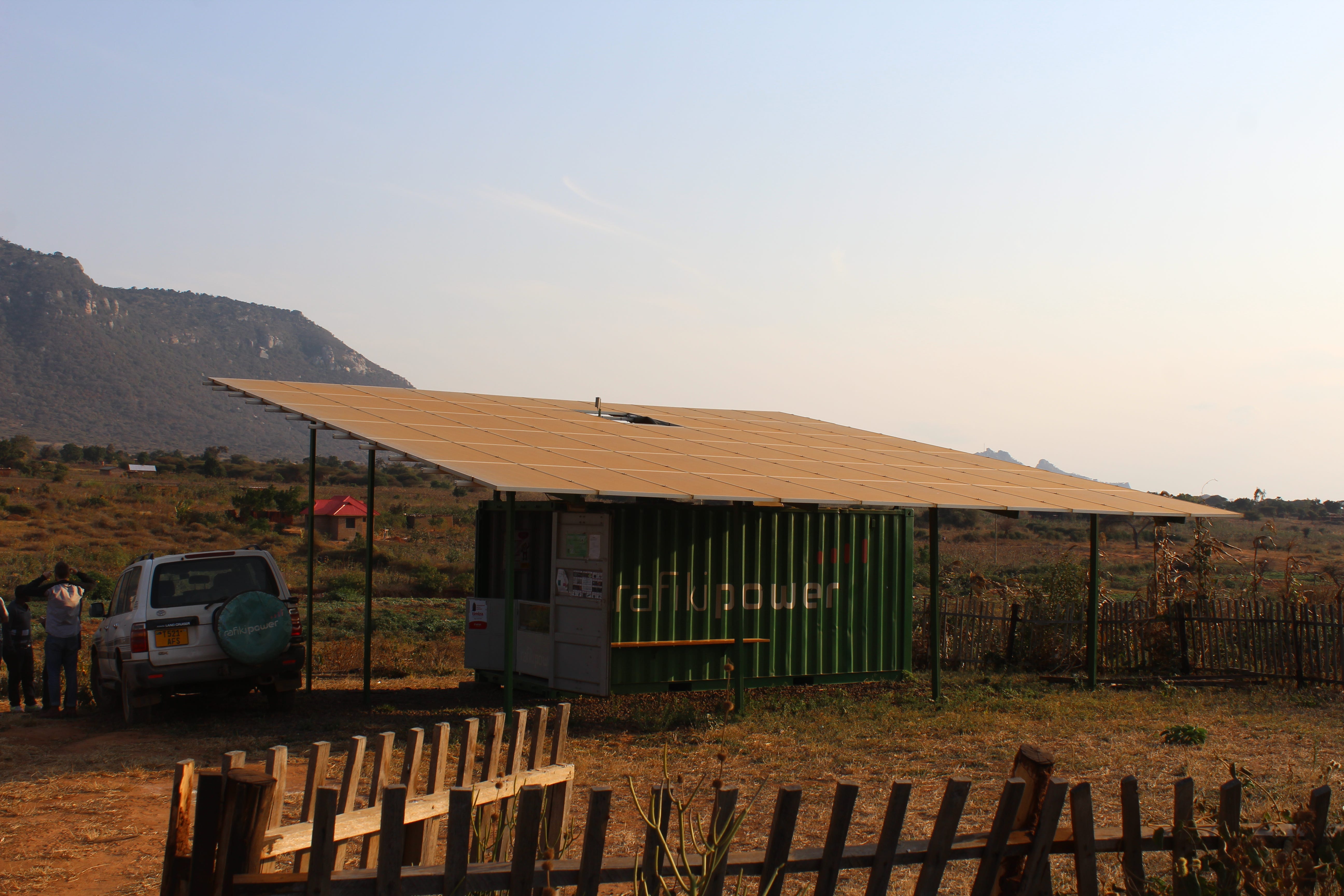
Data centres which start off-grid can deliver training compute from some of their electricity generation before the full site is commissioned. Computing technology is also improving so fast that some planned data centres are obsolete before they even break ground. Building energy and compute infrastructure in phases allows later stages of the development to include the newest technology, and in the meantime generates cash to offset construction costs. Systems using moveable solar and batteries can also be transported to other sites once the grid arrives if they are no longer needed as back-up power.
Building off-grid with a specific tenant in mind also reduces the risk of stranded assets. Utilities and energy developers may otherwise build infrastructure to meet an anticipated increase in demand that may not materialise if data centre developers cancel projects. Off-grid data centres would also help utilities avoid confidential bi-lateral agreements that lead to socialising the cost of the additional infrastructure across their customers.
3. Plan for when the grid eventually arrives
Grid arrival was a catastrophic outcome for several African mini-grid operators. To generate a profit, off-grid electricity providers often charge higher rates than the national utility even with capex subsidies provided by donors. The utility benefited from economies of scale, and often below-cost electricity prices for residential, low-consumption customers. It is politically desirable to offer customers cheap electricity connections via the grid as soon as possible, even if they are less reliable. If there was no enforced legal framework for what happened when the grid arrived, mini-grid operators risked losing their customers to a cheaper provider once they had already built all the infrastructure and created a market for electricity.
To counter this, mini-grid companies started building their systems with grid interconnection in mind. They pushed for clear agreements with utilities for the rates and compensation from grid arrival, and ensured their systems were interoperable to avoid duplicating infrastructure. They also often offer more reliable service than the grid, so can retain some customers with a higher quality product.
US data centres that choose to start off-grid should plan for the same eventuality. The grid might offer cheaper electricity once it arrives, or charge extra fees for the privilege of a reliable connection if it is not supplying much generation. Energy developers need to consider how that will look to their customers, and what happens once their electricity contracts expire. They could potentially sell resiliency services to the grid or even re-deploy systems elsewhere if their revenues are adversely affected by grid arrival. This requires building in a way that anticipates these two-way flows and ensures grid compatibility.
Where the analogy diverges: purpose, scale, and climate impact
Africa’s off-grid sector was solving for a humanitarian end, and it was often difficult to make enough money from rural customers to cover costs. Data centres in the US have no such problem, with customers willing to pay handsomely to access compute as soon as possible. Their impact by staying on grid may even be negative to the rest of the ratepayers. Going off-grid offers a way to limit the impact of data centres on energy bills.
The US’s off-grid push is also different from Africa’s in its potential for climate damage. Solar and batteries dominated Africa’s installations, usually with a diesel back-up. This was not only the cheapest and most reliable option but the cleanest. They could source from a wide variety of suppliers, at a time when batteries and solar faced few supply chain shortages.
Gas seems to be the preferred generation option for American data centres because it balances cost and reliability at a large scale. The US regularly builds hundred-megawatt- to gigawatt-sized data centres, up to five orders of magnitude larger than a rural African village’s off-grid supply[v]. This is dramatically expanding the potential for carbon emissions growth in the US, with 97 gigawatts of gas powering data centres in the pipeline. This is about the same size as the entire UK electricity grid.
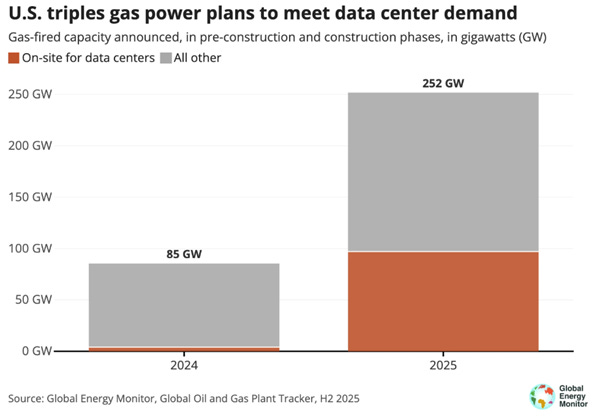
The time-saving advantage of going off-grid may be limited, though, by the shortage of turbines the data centre boom has itself created. Most gas developments in the US pipeline have not identified a turbine manufacturer, suggesting they have not actually secured their equipment order. Waiting for turbines may replace grid connections as the binding constraint in delivering data centres as quickly as possible.
The US could deliver speed with solar and batteries. They can be less cost-effective if they need to over-build to meet the reliability demands of a typical data centre. More importantly, they are politically sensitive and any imported inputs are at risk of tariffs.
Diesel could provide back-up to reduce oversizing solar and batteries the way it does on hybrid African mini-grids, but Jigar Shah recently illustrated the comical scale of the re-fuelling operation these require in a crisis. Unless a huge and dangerous amount of diesel is stored on-site, a 100 megawatt data centre would require a full tanker of fuel every 1 to 1.6 hours. In a genuine emergency, it seems unlikely they could access these endless trucks of diesel before hospitals and other essential sites.
The US lack’s a national carbon pricing framework to incentivise clean energy sources, and is diminishing the power of the Environmental Protection Agency to mandate health or environmental protections. Developments in geothermal and modular nuclear are promising but unlikely to be delivered in time to avoid the current gas construction wave. For now it seems gas is king.
In the off-grid communities I visited in Africa, getting electricity for the first time was life-changing. It enabled not only ‘productive’ uses like reading at night or powering work equipment but also supported entertainment and community. AI will of course be even more transformational for humanity but has real-world costs in the near-term. The desire for speed means infrastructure may not be funded fairly or could crowd out other uses. Going off-grid addresses some of these challenges, though with very different climate and health impacts if the US pursues gas in favour of Africa’s reliance on solar and batteries.
Either way, time is the scarce commodity. If tech companies want speed, off-grid data centres could help ensure that the cost of going fast stays off everyone else’s electricity bills.
Subscribe for more of my takes on the energy transition. Share with friends and colleagues and drop a comment with what you think.
[i] As described in a 2005 Nat Geo spread, gorgeous photos here.
[ii] This has eased off somewhat in 2024. Berkeley Lab.
[iii] Moussa Blimpo’s published an incredible World Bank paper in 2019 laying out a summary of all sorts of evidence and complexities of electrification in Africa, including reference to connections changing electoral outcomes and increasing the willingness to pay tax.
[iv] For example, this study examines the unit tariffs in Tanzania.
[v] In 2018 a 30 kilowatt system could power a 100-household village in East Africa, while data centres are being developed at gigawatt scale.
An extremely well written and timely piece - thank you.