
How essential is a service that provides 0.1% of London’s cars [1]? Very, judging by the reaction this week to car club, Zipcar’s shock exit from the UK. At stake is not just a transport service beloved by residents, but the environmental and land use benefits from fewer cars on the road. With calls for the Mayor of London and Transport for London (TfL) to protect and promote car clubs, subsidies and tax breaks could be coming. Instead, the city government could “municipalise” Zipcar at a discount and fix what’s broken about the car club business model.
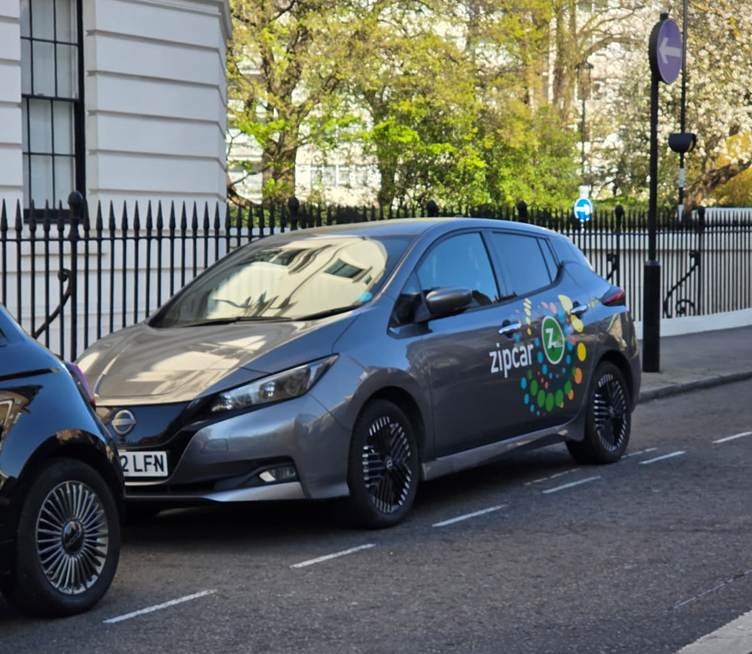
Car-sharing delivers on the city’s environmental and cost-of-living goals. Zipcars have lower carbon emissions than the average London car. One third of its fleet is electric against a city-wide average of 6.8% [2]. Car sharing fills a transit gap between public transport and ride-hailing, like moving house, one-off trips to visit relatives, or transporting bulky goods for work. This enables residents who rarely use cars to give them up entirely, saving on annual registration and insurance fees.
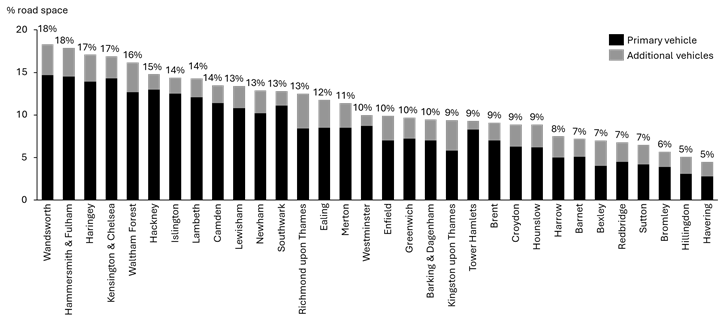
The bigger, under-rated prize is space. London has 2.6 million cars of which around 43% are parked on the street [3]. In 2017, parking took up between 5% and 18% of all road space [4]. By another calculation, street parking uses the equivalent of 1,300 hectares of public land, or nine Hyde Parks [5]. Recent analysis by Collaborative Mobility UK, a charity, suggests that each car-share in London pushes at least 16 privately owned cars off the road [6]. In 2022, they calculated that with a fleet of 21,000 shared cars, up to 300,000 cars could come off London’s streets after taking into account trip frequency, driver age, and accessibility. This implies each shared car could save over 150 m2 in parking space[7], roughly equivalent to the internal area of three new 1-bedroom flats. In addition to decreasing congestion on the roads, councils could use this extra room to expand pavements and bike lanes, provide more parking spots for dockless e-bikes or even create space for new homes and businesses.
Despite all these public benefits, privately owned Zipcar is struggling with costs. It posted a loss of ~£6 million in 2024, driven by a mix of falling revenues and rising expenses [8]. They also wrote off a tax benefit of an additional £6 million, perhaps foreshadowing their exit from the market [9]. Some of this is because of Zipcar’s business model. It includes fuel costs in the price, which have been rising, especially for electricity. Public charging costs are notoriously more expensive than charging at home or in bulk as a business, and Zipcar reimburses them. Its convenient one-way flex journeys also raise costs as staff manage re-charging. Customers can leave cars on empty, making them less appealing to the next driver, possibly reducing utilisation.
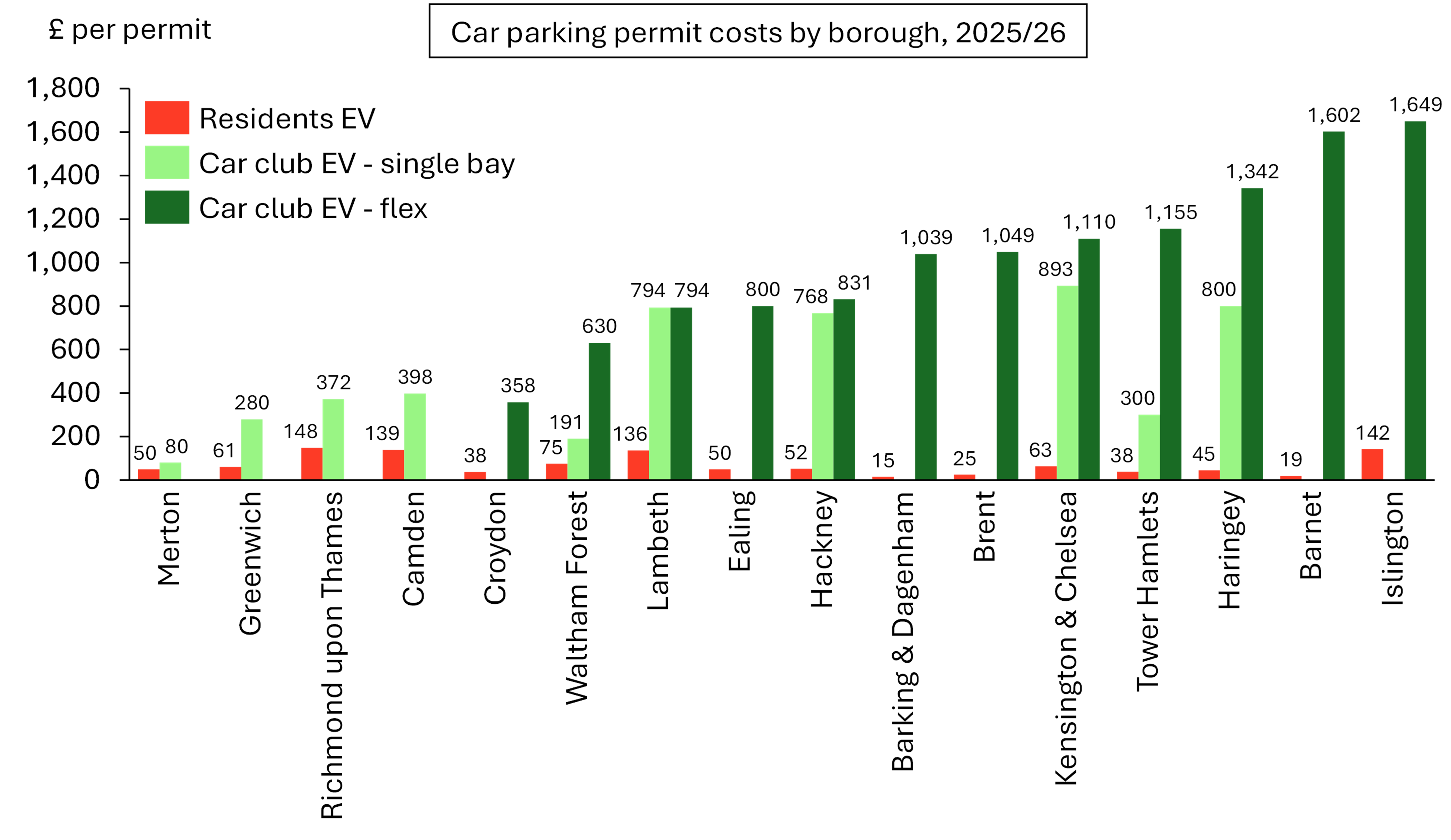
Local government isn’t helping on costs, either. Zipcar negotiates parking with each of London’s 32 boroughs, adding complexity. Rather than embrace Zipcar’s potential benefits, councils seem to fear missing out on revenue. They have ratcheted up parking fees on car clubs, especially on the flexible model that customers like. Councils charge EVs less than other cars to park, but while resident permits range from £15 to £150 per year, EVs in car clubs are often hit with fees that are six to 80 times higher, up to £1,600 for flexible parking. Haringey council even conducted a benchmarking study earlier this year to make sure they were charging as much as other councils, almost doubling flex parking and more than tripling fixed-bay costs.
Changes to city-wide and national policy are set to increase Zipcar’s costs further. EVs are getting hit by London’s congestion charge from 2026 if trips end outside the congestion zone, along with higher registration costs starting this year and new mileage taxes starting in 2028.
Against this backdrop, Zipcar’s departure is no shock at all. After letting policy costs proliferate, the surprise will be whether the Greater London Authority (GLA) does anything about it.
One option is to let Zipcar fail. This would disappoint thousands of users and potentially lead to more congestion if some of them buy cars again. It seems unlikely that a smaller player would scoop Zipcar up without any resolution of its underlying problems. This could potentially spell the end of car clubs as a viable business model in London, but maybe the GLA hope this would increase the focus on bikes and public transport.
Instead, London could explore “municipalisation”, treating car sharing as an infrastructure-like asset and bringing it into public ownership. Car-sharing benefits from economies of scale on charging and availability. It also provides public goods in addition to the service itself, reducing road congestion and carbon emissions, and freeing space for other uses. Municipalisation goes beyond subsidies or tax breaks, which could be offered to Zipcar without changing ownership. It re-imagines car sharing as part of the public transport system.
If car clubs became part of Transport for London’s offering, even as a standalone entity, it creates several distinct advantages versus private ownership. There could be better data sharing to inform planning across the system and connectivity with other services. TfL could use its land for parking and charging, and benefit from any bulk purchasing agreements for energy. TfL issues debt at just 5.75%, beating Avis’s intercompany interest rate of 7.1%. It could pass that cost of capital saving onto customers.
TfL might also have more leverage to negotiate a framework agreement for parking fees across all London boroughs. Councils would no longer feel like they are losing out on revenue to a private company, instead supporting a government body that they lobby for investment in roads, buses, and rail upgrades. TfL could tie the support of car clubs to increased investment in transport infrastructure as more space becomes available from fewer cars parked on the road.
This strategy carries risks, but they could be worth taking. One is finding the money for municipalisation. Even in a firesale, Zipcar’s vehicles could fetch upwards of £30 million [10]. This would potentially require outside financing partners but this is not an impossible sum to raise considering TfL’s debt is over £15 billion. Another issue is whether there is really as much consumer demand for car sharing as media reports suggest, given Zipcar’s recent decline in revenues. The number of shared cars in London apparently shrank by 12% between 2021 to 2024 [11]. Growing the fleet and coordinating better with the rest of the transport network could address this, as customers would see car sharing as a permanent option they can rely on. A third problem is whether a small service like car sharing is worth the hassle of bringing it into public ownership. A concession or not-for-profit model could also work, provided London fixes the problems first.
Zipcar’s demise is a policy choice. London has let a patchwork system of charges and rules get in the way of progress on reducing car ownership and improving land use. TfL has so far stalled on developing a pan-London plan for car clubs, according to the London Assembly. If London is serious about cutting congestion, freeing up land, and making infrequent driving cheaper, then Zipcar’s exit is the moment to prove it.
[1] 3,000 cars in Zipcar fleet out of 2.6 million cars in London
[2] June 2024 data, Transport for London
[3] Travel in London 2017 data, the latest available that provides car parking details by borough
[4] As above
[5] 43% x 2.6 million cars x 11.52m2 = 1,305 Ha, divided by 140 Ha area of Hyde Park. Previous estimates of 10 Hyde Parks by Centre for London were likely based on slightly higher car numbers and rounded space requirements from 11.52m2 (2.4m x 4.8m) up to 12m2.
[6] 31 cars per car-share if including avoided purchases of new cars.
[7] 12 m2 parking space and 300,000 fewer cars divided by 21,000 car shares = net 13.3 fewer cars per share-car after taking into account the share-car parking space. 13.3 x 12 = ~150 m2
[8] Revenues declining by £4.1 million and costs rising by £1.6 million.
[9] This tax write-off happens because they accrued some tax deductions in prior years that they no longer believe they can offset against future profits.
[10] Used cars sold for £17,000 on average in October 2025, or £23,500 for EVs. With 3,000 cars and a 50% discount, this would be around £30 million and covers Zipcar’s intercompany loan and outstanding leases.
Thanks for this! London might be able to afford this but i live in Edinburgh where, like the rest of the country, there doesn't seem to be any money left. Interesting that the swiss seem to have managed to get a cooperative solution going: https://mobility.ch/ueber-mobility/genossenschaft/mission-und-vision.. capital requirements aside, I wonder if that would work better? because when i've used these services before people really do not look after the cars, maybe some skin in the game would help..