
People care about energy costs. Oil and gas prices dominate the news whenever there is a conflict. But can you remember the last time you heard about the price of coal?
Although coal power was phased out in the UK last year, coal still powers 34% of the world’s electricity in 2024: more than any other fuel. Coal use globally has grown since the COVID19 pandemic, breaking new consumption records each year. After repeatedly predicting that the world would reach peak coal, the International Energy Agency finally revised coal consumption forecasts up in 2024. Despite the incredible rise of renewable energy, coal is still responsible for 37% of global carbon emissions as of 2023.
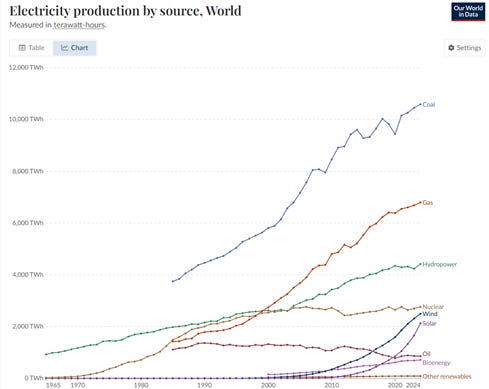
“Cheap coal” is one of the myths about why the world uses so much of it for electricity, which makes up two thirds of demand. Its low cost was one of the arguments in the FT’s feature last week about why the world cannot quit coal. Yet aside from a quote, they provided scant evidence for this claim. The FT is not unusual. The media often references coal’s “cheapness” without citing its price, let alone comparing its cost to other fuels. If you care about affordable energy bills or climate change, then this is a dangerous omission.
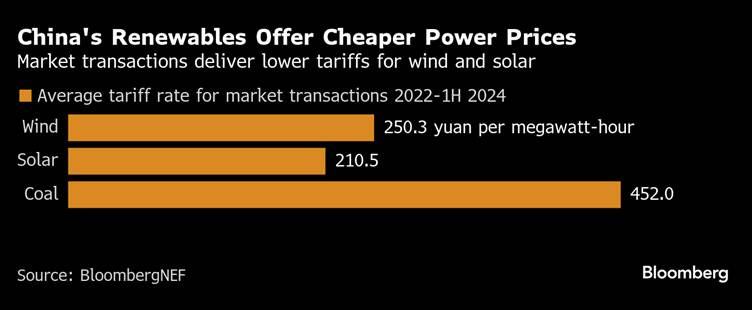
Take China, the country which produces and consumes more than half of the world’s coal. In China, renewable electricity is already cheaper than benchmark prices for coal power. Market-based coal power transactions are 81 to 115% more expensive than renewable options, according to Bloomberg data. Chinese coal was produced at $90 per tonne in May 2025, and this can generate 3.3 megawatt-hours of electricity according to China Electricity Council data. This implies a cost of $27 per megawatt-hour for fuel alone, before accounting for other costs like transportation and power plant operations. This compares to $15-18 per megawatt-hour for renewable energy[1].
The story is similar in India and Indonesia. The latter explicitly caps coal prices at $70 per tonne for local power generation, subsidising domestic electricity with more lucrative export prices that exceed $100 per tonne.
In the US, where Trump has pledged to support the coal industry, coal cost American electricity generators around $47 per tonne on average in 2024[2]. This implies a price of ~$30 per megawatt-hour, plus plant running costs, as American utilities generate electricity less efficiently than reported in China[3]. These can be high if a plant is beyond its useful life and requires extensive maintenance, or if coal plants are only running intermittently. Many coal plants in the US have closed as they can’t compete.
If low cost isn’t the primary driver of coal use, then what is?
Geopolitics and resource endowments partially explain why. Coal is a local fuel. It is less energy dense than oil, and long-distance transport costs can render its use uneconomic. Just 17% of the 8.8 billion tonnes of coal consumed in 2024 was internationally traded, compared to 72% of oil barrels[4]. Domestic coal not only generates tax receipts for governments, but can help to reduce reliance on foreign oil and gas. Coal-rich countries especially benefit from electric vehicles, as transportation is a major driver of oil consumption. Coal can also reduce reliance on manufactured energy products like solar panels, where China dominates over 80% of the supply chain.
Coal jobs are also important to domestic politics, if not in absolute terms then because they are highly concentrated. Eight million coal workers[5] make up just 0.25% of the global workforce as of 2023, or 12% of global energy jobs. However, these jobs are often concentrated in geographic regions, sometimes with entire communities established for the express purpose of extracting coal from the earth. If coal jobs go away, there may not be other employment opportunities to replace it.
This concentration strengthens political advocacy. For example, Senator Joe Manchin from West Virginia, a coal state with just 0.5% of the US population, had an outsized influence as the tie-breaking vote on the US’s landmark infrastructure bills. Supporting coal communities was an integral part of Trump’s 2024 election campaign, even though coal mining workers represent just 0.03% of the American workforce[6].
Although it can be costly, coal also can offer secure, reliable, round-the-clock electricity, especially for industries that cannot afford shut-downs, like data centres and metal production. Shock events like the 2025 Spanish blackouts reinforce public support for secure fuels. Coal-heavy power-grids are not immune to blackouts – ask any South African – but can improve public perception of energy reliability. The uptake of technology to enable flexible demand is still low, which would improve system resilience. Because renewable energy is intermittent, it requires energy storage to deliver power 24 hours a day, every day of the year. Solar and storage costs have come down enough to deliver 90% of the availability of coal and nuclear in some regions but reaching the final 10% can be prohibitively expensive.
The myth of cheap coal also hinders the ability to proactively support communities that will lose jobs, as it did in the UK and Eastern USA from the 1980s. From my visits to those areas, some still have not recovered. Replacing jobs without requiring relocation is hard, especially if regional economies experience a resource curse. It can be so lucrative to work in the resources sector that other opportunities like manufacturing are no longer attractive. Diversifying employment while coal is still generating income would help to alleviate pressure from future job losses.
The decline of coal has not truly begun in most Asian countries even as renewable energy is gaining ground. China has had an immense boom in renewable energy installations in recent years, including a stunning level of installations in the first few months of 2025. Solar and wind capacity in China is now larger than the entire US electricity system. The renewable capacity added so far in 2025 could produce the same amount of energy as Indonesia or Türkiye. China has introduced capacity payments for coal plants as part of energy market reforms, designed to provide a minimum level of revenue to keep plants operational if utilisation declines.
This renewables boom is partly driven by low-cost manufacturing, but also because of a glut of industrial capacity as the world pulls away from Chinese manufactured products on the grounds of energy security. China could eventually experience a decline in coal consumption, even if it is slow. Although coal use has not fallen yet, coal jobs likely will, regardless of how fast China’s energy system converts to renewable energy. A 2021 study by Alex Clark estimated Chinese coal jobs would more than halve by 2035, primarily due to productivity improvements.
Coal clearly has its benefits. It has been crucial for the economic transformation of countries like China and India, and is still the lifeblood of regional economies all around the world. Coal communities deserve the opportunity for meaningful work as much as anyone. But coal also has costs, to the environment, human health, and to anyone who uses energy. We should be paying more attention to whether coal is, in fact, cheap.
Thank your for reading. Subscribe for more analysis on ESG, energy and climate.
[1] Using today’s exchange rates.
[2] Using data from Table 4.1 of the EIA Electric Power Monthly release.
[3] 1.6 to 2 megawatt-hours of electricity are generated per tonne of coal consumed, data sourced from Table 1.04.a and Table 4.1 of EIA Electric Power Monthly release, corroborated with data from EIA frequently asked questions.
[4] Using 2025 Statistical Review of World Energy data on total global oil production and total global oil exports.
[5] Mining and supply chain (6.3 million) and power plants (1.7 million).
[6] In 2023, there were 45,476 coal mining workers in the US and a workforce of 171 million people.
Is there an additional angle here about the necessity of coal for industrial-grade heat? Many cement plants in emerging economies, for example, still prefer on-site, coal-fired power stations because coal is already used as a fuel to heat kilns for clinker production.
Interesting perspective. I do believe coal plants will eventually be replaced by green energy sources, but it takes time. Rome wasn't built in a day. China has a very large population, and in thinking the coal electricity plants in the long run are temporary sources of power. Only time will tell. https://www.substack.com/@stevenwpearce