
How much is a job worth? Certainly more than a salary. In addition to money, jobs offer purpose, community, and sometimes even enjoyment. Even though companies profit from someone’s work, governments still pay to create or protect jobs for all sorts of reasons, including national security. But at a time when people want energy to be cheaper and cleaner in addition to secure, is Trump’s latest $850 million subsidy for the coal industry good value for money? Not if its primary objective is really to save coal jobs.
US coal generation has primarily been replaced by gas over the past 25 years
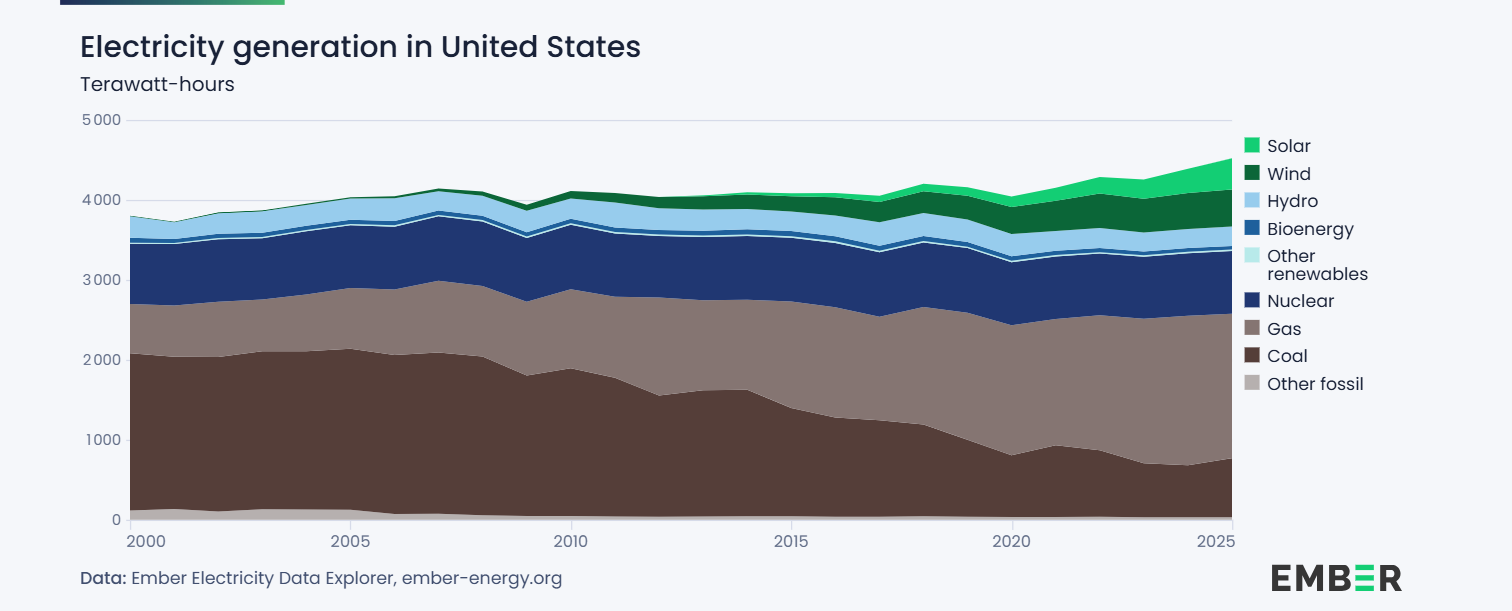
One of Trump’s signature second-term policies is to make coal great again, after he presided over the largest coal decline in history [i]. Over the past 25 years, coal mining fell by half and coal consumption in the power sector fell by 60%, primarily displaced by gas. More capacity was retired under Trump than any other administration. Coal now contributes just 16% to electricity generation versus 52% in the year 2000.
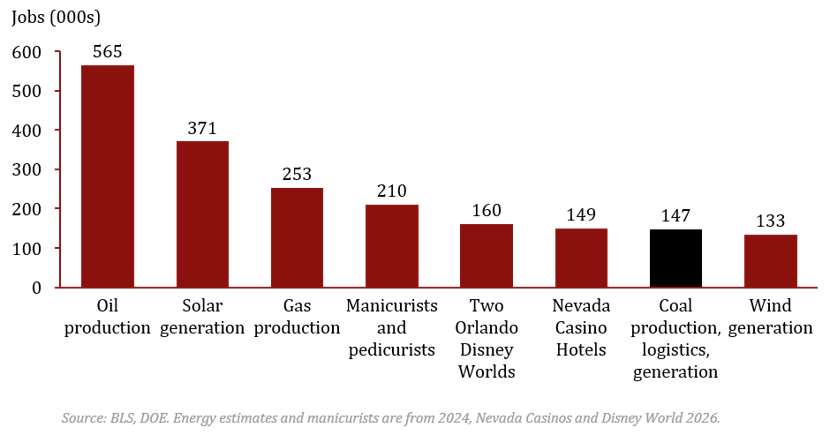
In addition to declining production, the workforce has shrunk to just 150,000 people across mining, generation, and logistics [ii], because the coal industry uses more machinery and prioritises the most productive deposits. Coal work is similar in scale to Nevada casino hotels, two Orlando Disney Worlds, or the nation’s manicurists.
Jobs of various occupations and sectors in the US, 2024 and 2026
Trump’s policies are an attempt to reverse this trend for the sake of protecting jobs, ensuring energy security, and reducing costs. Trump has slashed regulations and enforcement funding for environmental standards and worker protection. He has even cut federal taxes, which support the budgets of coal-rich states like Wyoming. He has thwarted the owners of coal plants who wish to close them, often because they are loss-making, requiring plants to stay open and transferring the cost to energy bills.
One year in, Trump appears to be succeeding, at least in increasing coal use. Coal mine production was up 4% in 2025 and coal power generation grew by 13% after years of decline. However, not all of this is because of pro-coal policy. Increasing demand from data centres and the expansion of LNG exports has raised gas prices and made some coal plants competitive again. The Energy Information Administration expects this advantage to be short-lived, forecasting coal use to fall again in 2026 and 2027.
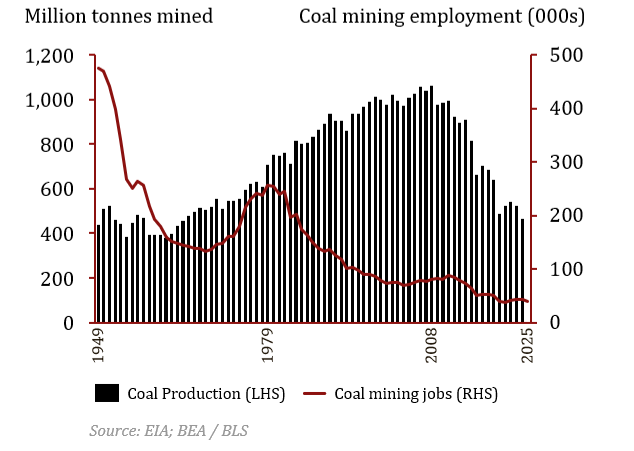
Yet even if coal use were sustained, more coal does not mean more jobs. Coal mining jobs fell precipitously from 1979 even as production peaked in 2008. The US has become a more efficient coal producer per worker due to mechanisation and extracting from the higher quality coal deposits. Mining in the Powder River Basin in the West is 10 times more productive per worker than in West Virginia, the heartland of American coal. Coal is now 1.7% of energy industry employment and less than 0.1% of the US labour force [iii]. If job creation is the goal, focusing on coal is a difficult place to find them.
US coal mining tonnage and employment over time
It also does not mean lower costs or more secure energy. Coal plants were scheduled to close because they cost their owners more to stay open than their value to the system. When they decide to retire them, they receive approval from the energy system operators to do so after a reliability review, ensuring there is sufficient capacity in the system. Capacity markets are one way of incentivising plants to stay on the system to ensure adequate supply, if energy revenue is insufficient to cover costs. Instead, plants were ordered to stay open citing an energy emergency. In one stunning example, extending the operations of the JH Campbell coal plant beyond its closure date has cost an additional $180 million in less than a year, beyond $221 million already charged to customers for energy. This excludes medical costs that lead to illnesses from poorer air and water quality and is unnecessary for reliably operating that grid network.
Yet last week, the Trump administration announced $850 million of fresh funding for the coal sector [iv], under the familiar guise of jobs, costs, and security. Despite these stated benefits, special defence powers were invoked to get the funding approved. $425 million will fund maintenance for 13 gigawatts of capacity, in addition to $820 million of private financing, often passed onto ratepayers, supporting almost 4,000 direct jobs at the plants and mines [v]. $75 million will fund an export terminal in California, one of the few plausible sites after fierce local opposition to coal developments along the West Coast. $350 million is earmarked for two new coal plants in Alaska and West Virginia, and restarting plants in Maryland and Puerto Rico. This builds on $175 million promised in February to maintain six plants in Appalachian states.
Coal power supports mining jobs upstream in addition to direct jobs at plants
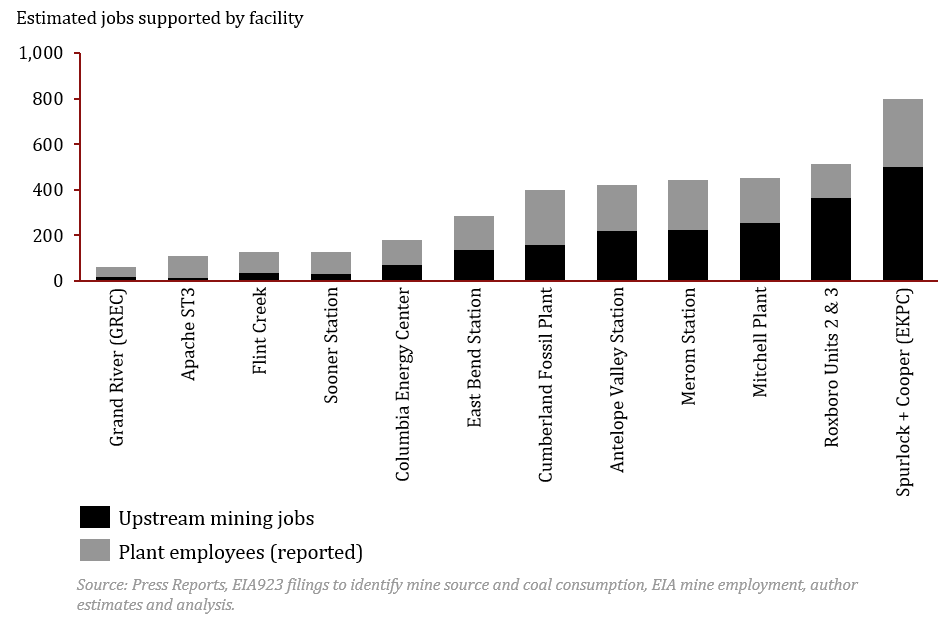
The government has provided little evidence that these investments will reduce cost or increase energy security. Allegedly, the government’s initiatives to keep over 40 gigawatts of coal capacity online [vi] will avoid $50 billion in investment billed to ratepayers, with no meaningful analysis provided for this claim. This presumes that each site would cost $1.25 million per megawatt to replace and excludes any counterfactual comparing operations costs of new technologies and coal plants, and the associated medical and environmental burden. A diversified portfolio of renewables, nuclear, gas, batteries, and even demand flexibility technology is already meeting system energy needs, which is why operators are comfortable signing off on retirements when owners want to close. Rising data centre demand has put strain on some networks, but it’s not clear extending coal plant life is the best way to alleviate this pressure. Local energy system operators and infrastructure owners are evaluating cost and benefit trade-offs of different energy technologies. The federal government does not appear to be.
If investing in coal is really about jobs and not energy security or cost, then it is an expensive endeavour. $700 million of the funding announced last week is expected to add or support 14,000 jobs, costing $50,000 per worker on top of their compensation. At the extreme end, protecting 450 to 550 jobs supported by the JH Campbell facility [vii] costs ratepayers $400,000 to $500,000 a year [viii]. However, when this shows up as just $4 on each of 45 million energy bills [ix], it will be hard to hold the government accountable for inefficient spending.
There are surely cheaper ways to support decent American jobs, especially when the energy security benefits of coal can be met with alternatives. The Economic Development Administration’s own figures for infrastructure projects show the average cost to protect or create a job is $13,500. Government funding for apprenticeships cost $5,000 per place on average, while training a solar installer costs private individuals up to $10,000. Small Business Administration loan guarantees for businesses with major fixed assets are offered when a loan can generate at least one job per $90,000 to $140,000 of funding, and these guarantees are usually cost-neutral for the government. These are all far lower than the current coal subsidies per worker. The government could instead expand programs for retraining and supporting business investment specifically into regions affected by coal decline.
The debate on the most cost-effective way to keep or grow jobs does not seem to be happening, perhaps in part because winning over voters with jobs is not really the goal. The nation’s two largest coal states are home to 2.4 million people combined [x]. Even with over-representation in congress and the electoral college, the employment opportunities coal presents are insufficient to win an electoral numbers game. A much larger voting block cares about coal workers and Trump’s solidarity with them because of what they represent.
Coal mining is a symbol for the type of job that has gone away: one of hard work, community, and pride. Even if relatively few people work in this industry, advocating for the coal miner is synonymous with advocating for masculine, high-paying, blue collar jobs with purpose. The bravery and camaraderie of coal mining culture is hard to match in jobs that replace it. This is increasingly difficult to find in the modern workplace without signing up to the military or emergency services.
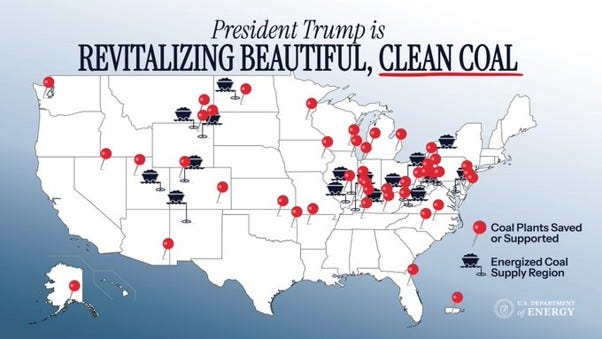
An example of US Department of Energy coal memes

The government’s meme-ification of coal [xi] to boost its profile is another part of this symbolism strategy. Coal has become a larger part of the national political conversation than its contribution to American energy and employment would suggest, because it is a discussion about values instead. This matters because it distorts decisions on how best to keep American energy costs down and support people to find new opportunities and purpose.
Preserving a culture of hard work and dignity is a valid political goal, as is creating jobs and supporting communities to thrive. The trade-off is whether this should be funded with higher energy bills and taxes, using a technology that causes more health and environmental harm than its alternatives. It’s possible that a coal job is worth up to $500,000 to protect each year. But if what Americans really care about is more job opportunities and lower energy bills, I suspect there are better ways to spend that money.
Join 1,000+ followers by subscribing to my Substack for more longreads on the energy transition. Share this piece with others if you found it interesting, and leave a comment or reply to this email with your thoughts.
[i] I think this is a funny framing by Carbon Brief but clearly not causal, as retirements are planned years in advance and Trump’s first term policies did not particularly change market conditions to make coal retirements more likely.
[ii] The 2024 report summarises all coal-related jobs at 152,891. This includes fuels, electric power generation, and fuel transmission and distribution, the last of which was 22,613 jobs in 2023. The 2025 report does not provide the figure for fuel transport and reports 5,427 fewer jobs in 2024 in fuels and electric power generation.
[iii] 147,000 workers out of 8.5 million = 1.7%, from the USEER report and analysis outlined above. There are around 160 million in the US Labour force, US Bureau of Labor Statistics.
[iv] There is considerable discrepancy in the media on what was reported at a White House Press Briefing versus what was included in multiple the Department of Energy press releases that day. I have added up all the subsidies I could find for a total of $850 million, rather than relying on the White House Press reports only.
[v] Author’s estimate, using coal consumption data by plant (EIA), mine efficiency (EIA), and press reports for plant workers where available and estimates for Apache and GREC.
[vi] Including by forcing them to stay open using emergency orders.
[vii] 250 people or so work at JH Campbell itself, all of whom had been found alternative employment. 2025 consumption of 3.6m tonnes from Black Thunder and 0.8m tonnes from North Antelope Rochelle (EIA 923 data) supports the employment of around 100 mining jobs based on the productivity of those mines. 100 to 200 rail workers are estimated but this figure is harder to pin down.
[viii] $180m in costs from May 2025 to March 2026, annualised to a full year, divided by 450 to 550 jobs.
[ix] $180m in extra charges billed across 45 million MISO customers. March 2026 filing by Consumers Energy.
[x] West Virginia (1.8m) and Wyoming (0.6m), US Census 2025.
[xi] In researching this piece, I found this incredible series from the Guardian in 2015 turning coal memes on their head.
I find this quite convincing. I wonder whether anyone in the US government is thinking about it in these terms and debating whether or not this piece of symbolism is worth the cost.