
New York City’s Housing Authority (NYCHA) buildings’ electrical wiring was so old that installing typical electric cookstoves wasn’t practical, even if they could save money and make the air cleaner. The power required for an electric cookstove could overload the sockets by up to 400% [i]. However, for most of the day, individual sockets are otherwise underutilised. Rather than rewire every flat, NYCHA installed stoves with built-in batteries to get around grid constraints.
Battery charging over longer periods enabled the cookstove to run at a higher capacity than the socket for short bursts, avoiding rewiring. These cookstoves could also lower costs by charging when electricity is cheapest, but the primary win is being able to use high powered appliances without needing to upgrade network infrastructure. Batteries also enabled these stoves to remain resilient during power cuts, one of the advantages of the gas systems they replaced.
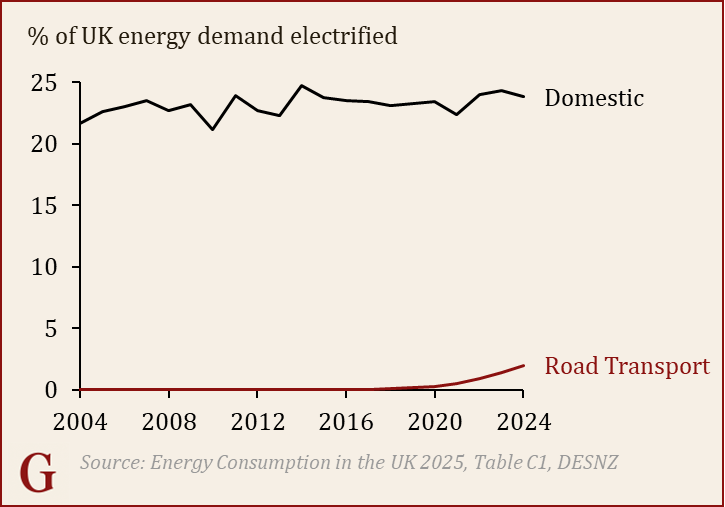
Electrification is still in its infancy in Britain. Just 5% of cars and 13% of household heating systems are powered by electricity [ii]. As more households consider making the switch, it won’t just be electricity supply that comes under pressure. Local distribution networks could become overloaded. Batteries are currently used for demand shifting and network stability. If last-mile distribution upgrades start to fall behind in the UK, batteries could also help meet increasing peak demand by charging at low power then discharging at high power.
The UK has not yet electrified the vast majority of its domestic and road transport energy demand
Networks are designed for managing peak power demand even as average utilisation has declined [iii]. At a household level, this over-sizing is stark. The amount of electrical power that can be delivered by a connection is a function of current, and voltage, which is standardised at 230 volts in the UK. Older British homes connect to the electricity network at 30 to 60 amps of current, which mean they can handle between 7 and 14 kilowatts of peak load [iv]. This is not a trivial portion of homes: 71% of England’s 26 million homes were built before 1980 when higher currents (80 to 100 amps) were introduced [v], and 34% was built before the end of World War II [vi]. With a median domestic electricity consumption of around 2.5 megawatt-hours per year, this implies an individual household connection uses 2% to 4% of its rated capacity [vii].
Older individual household connections could become overloaded by electricity-intensive tech. A standard electric vehicle (EV) charger is 7 kilowatts, while a heat pump load can be 3 to 4 kilowatts. Together with an ill-timed kettle boil and washing machine load, this could exceed an older household’s rated capacity [viii]. Unlike NYCHA’s predicament, a free upgrade to 100 amps is a common remedy and doesn’t take long for UK network operators to do. The real issue could become managing street-level constraints.
Secondary substations, the last mile network infrastructure before power flows to properties, are not as oversized as household connections. Households use peak electricity at different times, varying with work and lifestyle habits. Secondary substations are sized for “After Diversity Maximum Demand”, with the median National Grid Electricity Distribution substation using 36% of its rated capacity according to Regen. However, 7% of substations are already overloaded, and a further 10% have over 70% utilisation.
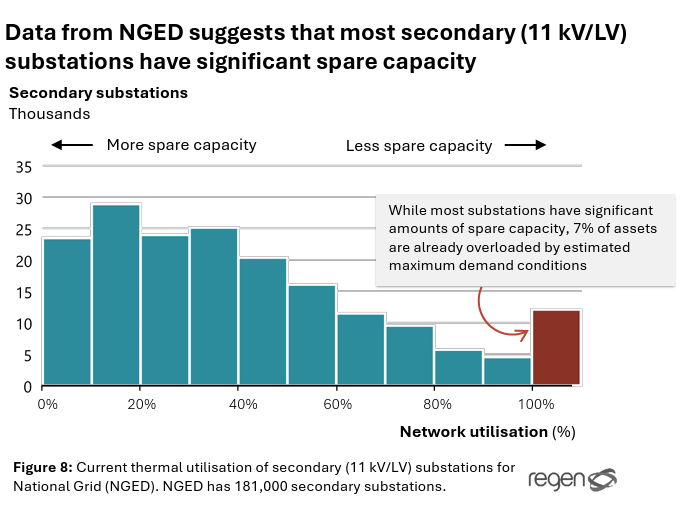
This could worsen as more households electrify heating and transport, especially if demand is correlated. 78% of English households own a car, but just 5% of them are currently electric. 80% of British households use oil or gas boilers and may consider replacing them with heat pumps. Automated demand management could help to reduce correlation. But for demand that can’t be shifted easily through automation and for a higher peak load level overall per household, home batteries could alleviate pressure on substation upgrades.
Home batteries in the UK are not currently used for this purpose, instead supporting load shifting and grid services. Using a battery at a low charging capacity with a high discharging capacity would spread more demand throughout the day when the household’s grid connection has lower utilisation and enable households to use high powered devices for short bursts.
For example, one of NYCHA’s cookstove providers, Copper, only draws 1.4 kilowatts of power so its 5 kilowatt-hour battery would take at least 3.5 hours to fully charge [ix]. It discharges at a much higher capacity, up to 10 kilowatts. Its charging C-Rate, the ratio of storage capacity to power supply, is 0.29C, while its discharging C-Rate could be as high as 2C [x].
Similarly, home batteries could deliver electricity to devices in a household at high power levels, without needing to be charged at this same capacity by the grid [xi]. A higher power rating for discharge, with a throttled import capacity, could buy utilities time for distribution upgrades without hindering EV and heat pump adoption, and may negate the need for an upgrade at all in parts of the network. This is distinct from existing flexibility markets as this asymmetric use of home batteries can physically reduce the peak demand seen by the local network for inflexible loads over sustained periods [xii].
In the private sector, this network capacity arbitrage with batteries already happens at an industrial scale. Zenobe, an electric bus and truck leasing company, uses batteries to deliver higher power to its chargers when the network is constrained. For its London bus charging site in Southall, grid upgrades were more expensive than using a battery at a low charging C-Rate on its existing grid capacity. Zenobe secured a 500 kVA grid connection (circa 500 kilowatts with some losses) and supplemented it with a battery that held up to 1,200 kilowatt-hours. This battery could theoretically charge at the maximum grid load of 500 kilowatts, taking 2.4 hours to reach full capacity, but discharge at up to 1,200 kilowatts for up to 1 hour. This enables, at peak times, up to 1,700 kilowatts of power delivery without drawing on grid power by any more than 500 kilowatts at a time.
At home, it’s not clear who would pay for the benefit of a grid-deferral battery. The UK already has a trading marketplace which allows batteries, including those within EVs, to earn revenue by shifting demand between cheap and expensive times or by providing grid stability services. Households can also use batteries to improve the utilisation of rooftop solar, saving money from avoiding more expensive grid electricity consumption.
Deferring grid capex is not yet an established revenue model for batteries. Managing grid upgrades is the responsibility of the distribution network operators, and last mile batteries could eventually be funded by the networks themselves, avoiding the risk of stranded assets and providing them with oversight of their various use cases. A third-party-led model, however, could potentially be delivered faster if the framework for remuneration were clear like it is for other battery use cases.
The capacity constraints of larger scale network infrastructure are well known, alongside delays to connect generation and demand up to the grid. Constraints on the last mile household connection side, meanwhile, are getting less attention. Consumer demand for EVs and electric heating looks set to rise as energy security and cost management become even more important.
If last mile networks become the binding constraint for a household to connect an EV charger or switch its heating supply, this will frustrate people trying to bring their costs down. Home batteries to defer network upgrades could be an option to help solve this before it becomes a problem for electrification, if we can figure out how to regulate it and who will pay for them.
Join 900+ followers in 52 countries by subscribing to receive my regular long-reads on the energy transition.
News & Events
I published a report with Ed Hezlet and Centre for British Progress on how to speed up grid connections - have a read here.
April 29th, 9am-11am, Unlocking Pension Capital for the UK Energy Transition
April 29th, 12-1.30pm, Innovation Zero Working Group on the future of cleantech. Hit reply for a free conference ticket.
May 25th, 7pm, Pints of Knowledge Pub Talk on Why Coal Powers On
Footnotes
[i] Sockets were 120 Volts, rated for 20 Amps, i.e. 2.4 kW of peak power (voltage x current = power). Stoves like Copper have 4 hotplates, which could each peak at 2.8 kW even if for a short time. Their battery capacity is 5 kWh.
[ii] Main method of heating used, DESNZ Public Attitudes Tracker Winter 2025, England. Heat pump installation rates are low (1-2%), the balance is electric boilers, radiators, portable and storage heaters. Electric heating is also a popular secondary heating method.
[iii] For more on this, see my grid connections paper with Ed Hezlet and Centre for British Progress.
[iv] 60 Amps x 230 Volts = 13.8 kW.
[v] They were introduced since the 1980s, more detail on this history is at Energy Networks Association.
[vi] Housing stock statistics for England, Annex 1.4.
[vii] 2,471 kWh consumption over a potential utilisation capacity of 365 x 24 x power rating (7 or 14 kW) = 2% to 4%
[viii] Appliance peak power from Electrical Safety First, kettles are up to 3 kW and hair dryers 2.2 kW. Toasters, dishwashers, dryers, washing machines, and vacuum cleaners also use around 2 kW each.
[ix] The manufacturer states it takes about an hour to charge to 20%.
[x] 10 kW peak discharge divided by 5 kWh battery storage = 2C, or 1/2 hours of use. 1.4 kW charge capacity divided by 5 kWh of battery storage = 0.29C.
[xi] Some battery systems are limited by the network operator’s simpler connect and notify export limit of 3.68 kilowatts (G98 rule). Export connections above this size are not automatically approved by the network requiring a G99 application or a G100 export limitation, so some households choose smaller sizes to reduce connection hassle and uncertainty.
[xii] My understanding is this is currently limited in part by G98 regulation designed to protect the grid, and using the smaller inverter is simpler rather than agreeing to throttle a larger inverter.
Great read! Clearly, there is increasing activity in this part of the grid.
There is a similar concept with A/C, also in New York. A company called Every Electric provides “plug in” batteries that can help peak shave the A/C power demand.
Great read. hadn't considered the charge/discharge asymmetry as a way to reduce pressure on substation builds before.
Taking a step back, your "who pays" question is one of two adoption barriers for home batteries I’m thinking about:
1. financing: the Warm Homes Plan’s zero/low interest loan is a good nudge for homeowners to get batteries. But for landlords/renters - who’s willing to own the upfront CAPEX, and are the WHP financing options attractive enough to make the economics work?
2. space, adoption and aesthetics. Batteries take up space. Without garages, bulky boxes are a hard sell for renters and smaller homes. There’s also the hassle of installing these batteries and switching to flexible tariffs. Might be a drag for the non-industrial user.
Spoke to the founder of Windfall Energy recently. They are trying to solve these adoption barriers through a plug and play home battery storage solution, emphasising aesthetics and low friction to install. But he acknowledges the financing and tariff switching barriers. They are figuring out a biz model that partners with energy suppliers directly to include Windfall Batteries in tariff packages, so consumers don’t think about it.
But Windfall Battery’s specs is counter to your substation bottleneck: it’s a 1200W/800W input/output setup for a 2.5kWh battery.
Wonder if that asymmetric discharge becomes a bigger pain for these domestic-focused solutions to solve in the future, or if its gonna be taken up by industrial-focused companies like Zenobe.