
The UK’s incumbent renewable energy generators have gotten an unusually good deal since 2020. High wholesale prices. Excess inflation. Paid even when electricity can’t be dispatched. With electricity bills up 60% from 2020 to 20261, something has got to give.
The government has been giving, by taking policy costs off bills for households and businesses, and the new administration is likely to continue reducing levies to make electricity cheaper relative to gas. They also proposed optional contracts, “Wholesale Contracts for Difference (CfDs)”, for existing renewables projects to reduce the link with gas prices. As part of the devolution agenda, the next government should go further by finally delivering locational pricing reform. The benefit of doing both is that contracts and pricing reform reinforce each other: wholesale CfDs as a transitional measure help to overcome opposition to reform, while the uncertainty of a major reform will motivate more generators to opt into a low fixed-price deal. This could deliver billions of pounds of cost savings and send the right price signals for future regional investment in energy generation and consumption.
For decades, the UK has incentivised renewables development with a combination of carbon taxes to elevate wholesale prices of coal and gas, and revenue support for renewable generators. Around half of all renewables generation in 2025 receives price support via Renewable Obligations (ROs), a program launched in 2002 that pays a subsidy on top of wholesale prices. Feed-in Tariffs, still covering around 5% of all renewable generation, offered similar top-up payments to small generators in addition to tariffs if they exported power to the grid. When ROs closed to new projects in 2017 and Feed-in Tariffs in 2019, Contracts for Difference effectively replaced them. CfDs guarantee a fixed price to generators and now support over a fifth of renewable generation. Each of these contracts is indexed to inflation2, so prices rise even if the underlying costs for the generator do not.
Installed capacity by subsidy scheme, and wholesale prices plus RO subsidies
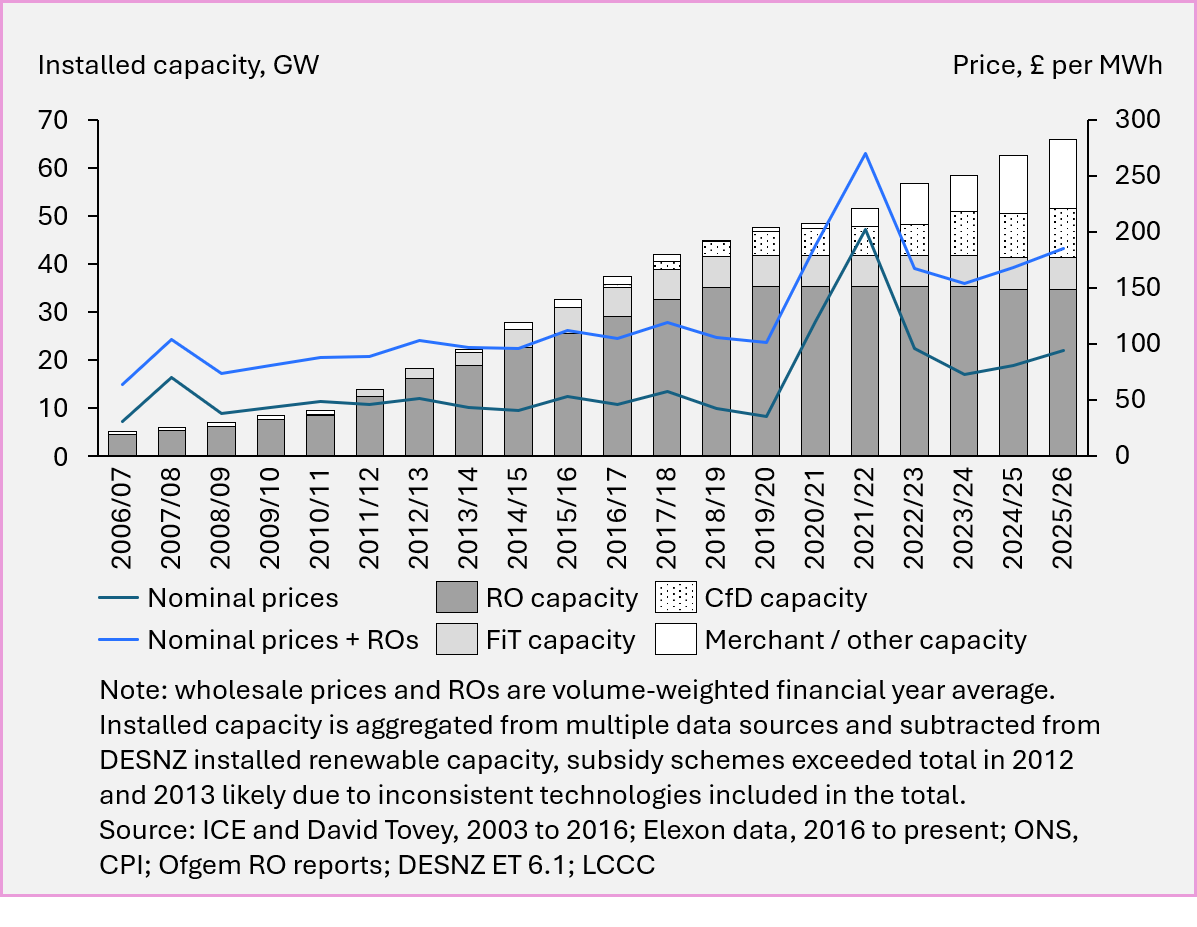
Investors made decisions to build renewable projects based on these subsidies and assumptions on inflation and wholesale prices. Build costs and interest rates are often fixed up front, while inflation and wholesale are risks that they bear over the life of a project. Ideally projects would generate enough returns with their contracted revenue to justify the deal, but as the market became more competitive, they would need to factor in uncontracted revenue as well.
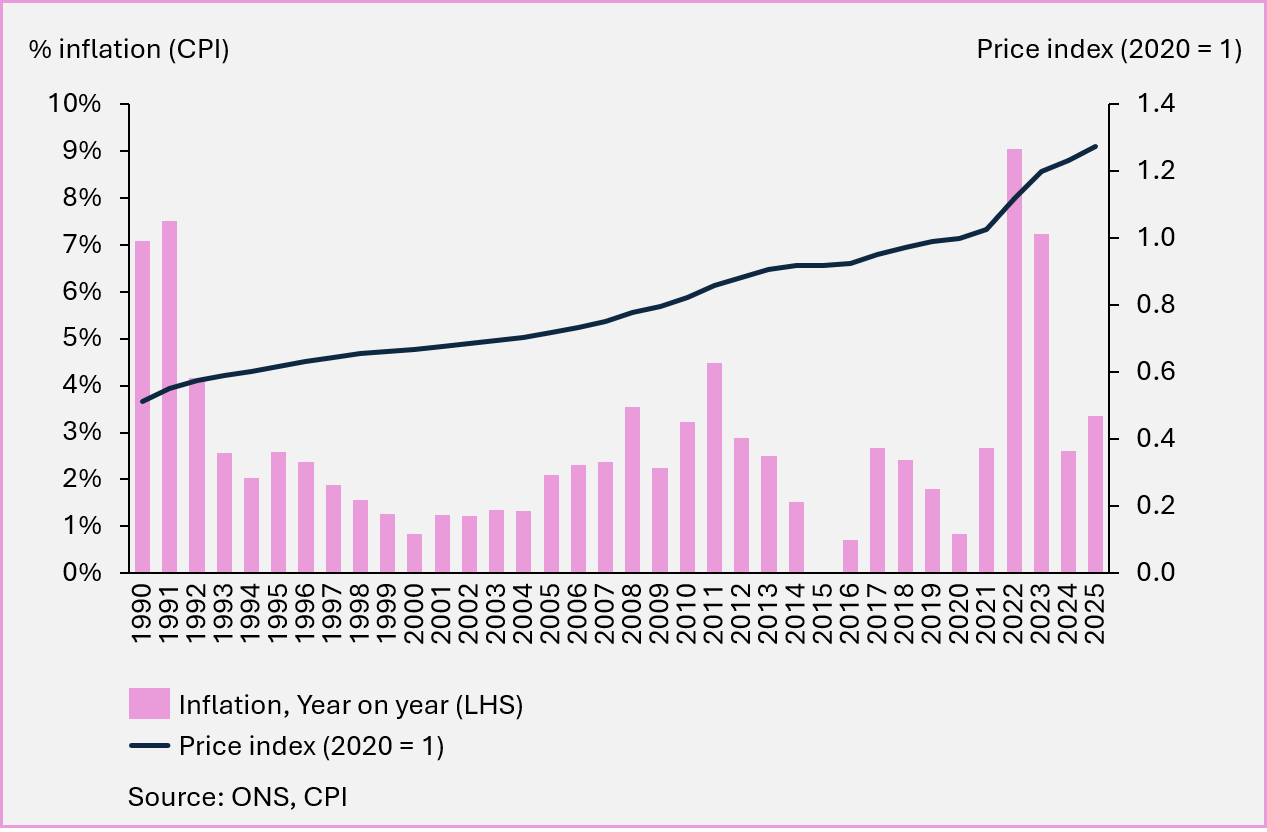
Since 2020, inflation has exceeded expectations, benefiting anyone with a project already in the ground receiving contracted payments. Inflation rose from a compounded average of 2.2% between 1990 to 2020 up to 4.9% between 2020 to 20253. Incumbent generators increased contracted revenues by 27% over the five years to 2025, which would have taken 11 years to accumulate at the historical average.
Inflation
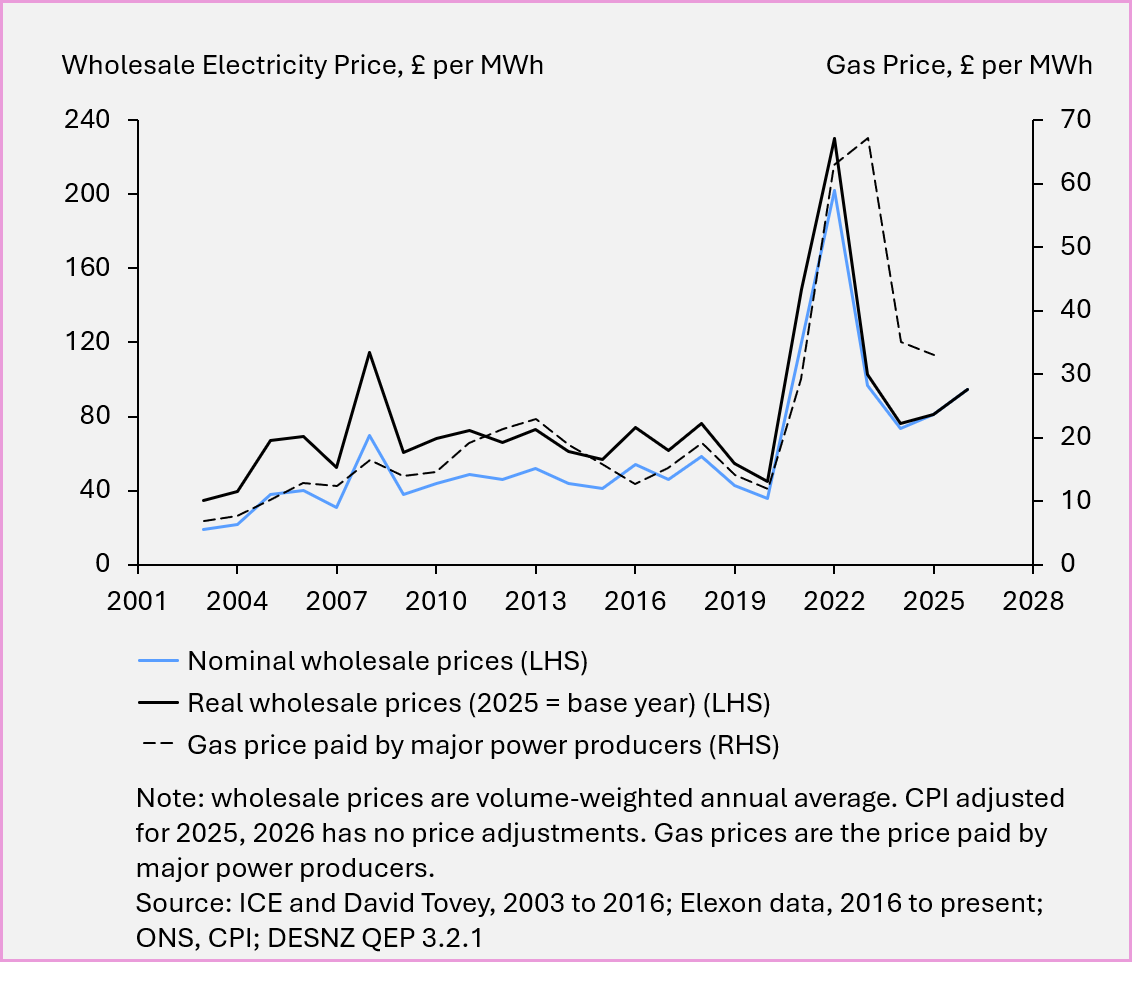
Generators receiving RO payments rather than CfDs also benefited from elevated wholesale revenue. Wholesale prices averaged £42 per Megawatt-hour in nominal terms between 2003 to 2020 when gas and coal dominated the grid, or £63 per Megawatt-hour adjusted to 2025 prices. Average wholesale prices from 2021 to 2025 are double this historical trend in real terms, and closer to triple in nominal terms. Although the share of fossil fuel generation has fallen, gas still drives the price of electricity as the marginal generator most of the time4. International conflicts constraining supply and higher carbon prices have increased gas costs, in turn increasing the wholesale revenue for renewable generators. Projects with ROs receive this elevated wholesale revenue in addition to payments averaging £91 per MWh in 2025/26.
Wholesale electricity and gas prices over time
Against this backdrop, the government has proposed optional wholesale CfDs to break the link between gas and renewable prices. If nothing else, contracts will offer price stability, but the government also expects them to reduce energy costs. However, critics are worried the government will sign up to these CfDs at the top of the market, just as renewables might finally trigger lower wholesale prices. These CfDs also leave ROs subsidies intact, now costing £7 billion per year.
The government should only offer wholesale CfDs that will save money in absolute terms, and pre-2022 crisis levels are a reasonable target. If the government negotiates them at close to pre-crisis levels, £67 per Megawatt-hour in the 2010s adjusted for inflation, they will save 30% compared to 2026 prices, or up to 50% if they reverted to the 2010s nominal average. Investors historically built projects knowing at these prices and have since paid off more of their capital5.
There are at least four factors in the government’s favour that make these prices achievable:
1) Contracts reduce risk, which in turn reduces the returns that investors are willing to accept. This would enable a resale or refinancing at a lower cost of capital, potentially also generating a windfall payment.
2) The CfD structure is also a more binding legal contract than government subsidies, which may motivate opting in if investors fear an anti-net-zero Reform or Conservative government at the next general election. Investors may even be willing to bundle a lower RO payment into a CfD negotiation as well.
3) Investors also may wish to insure against a collapse in wholesale prices that can occur when generation is correlated with weather events, a phenomenon that has impacted solar and wind projects in Europe but has not yet materially eaten into UK generators’ revenue.
4) The government increased the Electricity Generator Levy. This 45% tax on ‘exceptional generation receipts’ already applied to low-carbon generator revenue above ~£75 to £80 per Megawatt-hour6. Bumping this up to 55% further limits the upside that a generator would receive if they opted out of the wholesale contracts.
This may not be enough without more at stake. Private companies are not compelled to give up their super profits even if they have already earned outsized returns, and the chance of revenues collapsing to pre-crisis levels in the next few years seems low while the UK maintains a national wholesale market. The backlog in grid connections and delays in commissioning reduces the speed at which more renewables can displace gas off the market, and demand growth from electrification and data centre expansion will put upward pressure on prices.
Enter locational pricing reform.
Britain’s national wholesale electricity market incorporates time constraints, but not geographical constraints. A generator can still earn revenue even if the grid is unable to physically transmit the power plant’s electricity to where it is needed. This demand must still be met by another provider, requiring a second payment to an additional generator delivering energy where it is needed at short notice. These ‘balancing payments’ cost £2.2 billion in 2025/26 and are forecast to rise to £8 billion by 2029/30. A locational price would alleviate these constraints by pricing them into the bidding process between buyers and sellers.
National pricing also blunts price signals for new demand and supply, while locational pricing could become a negotiating lever for regional governments. Businesses like data centres or factories could be attracted to build power-intensive facilities in oversupplied, low-price areas, and local governments could incorporate this into their industrial strategy. Suppliers could also offer lower prices to households that opt in, reducing wasted energy. Even if customers are never exposed to a locational price, this would increase the incentive for new generation to build in places where prices are higher. If introduced alongside more community ownership and local government agency, this could motivate communities in high priced areas to permit more projects.
Despite benefits of locational pricing reform for households and businesses, the private sector successfully opposed the change. When the Review of Electricity Market Arrangements concluded by keeping national pricing in 2025, the higher cost of capital from uncertainty was cited as the reason to avoid reform. A more cynical read is that incumbents didn’t want to lose the excess rents created by national prices. Instead, the government introduced locational pricing by stealth, for example through targeted electricity subsidies to data centres in over-supplied locations7, the grid connection queue re-shuffle, or the top-down Strategic Spatial Energy Plan to identify where power should locate.
A transitional measure like wholesale CfDs would reduce opposition from incumbents, while reshaping the incentives of the market to avoid waste and attract investment to regions where it is most valuable. Reforming wholesale markets would also make the wholesale CfD more effective at reducing energy bills in the short term, as incumbents are more likely to opt in to reduce their risk.
Doing both at the same time has risks, like adverse selection and reducing the pressure on network operators to invest in alleviating constraints. Incumbents in places like Scotland who stand to lose out from locational pricing reform would be more likely to opt in than those in regions with high demand and low supply. Right now, there are even fewer incentives to opt in, and subsidising incumbent generators through the change is also a small price to pay if reform can finally be delivered. Locational prices would also enable batteries and other flexible technologies to alleviate grid constraints more cost effectively, instead of relying solely on network infrastructure or ancillary services markets.
Regardless of the risks, the current market situation is untenable from a cost and efficiency perspective. Introducing locational electricity pricing alongside the proposed wholesale CfDs will help to blunt opposition to a transformational market reform and increase the negotiating power of the government in delivering low-cost contracts in the short term. Reforming the wholesale market will give regions more investment signals to work with, like attracting businesses to places with low energy prices and generators where there are high energy prices. Locational prices are an essential part of enabling devolution, cost reduction, and growth. The next government should prioritise its delivery.
Join over 1,000 followers in 60 countries and subscribe for more analysis on the energy transition.
Listen to my podcast, Power Plays, for more on Andy Burnham’s approach to energy and breaking the link between gas and renewables prices with wholesale CfDs.
Ofgem price cap standard credit, FY 2020 and FY 2026 annual averages.
Though different types of inflation. ROs and FiTs were linked to RPI, typically higher growth than CPI, while CfDs are linked to CPI. The government has since phased out RPI and now all contracts are on CPI as of 2026.
Using ONS CPI as the measure, and Compound Annual Growth Rate (CAGR). Using CAGR has an end-point selection bias – 1991 to 2021 produces 2.1% while 1989 to 2019 produces 2.4% - while a straight average produces 2.3%. Using a straight average of inflation percentages underweights the effect of compounding in an outsized year.
DESNZ reports this as 60% while Modo Energy reports this at 85% because they use different methodologies.
Buy-and-hold or exited investors likely exceeded their expectations. Investors buying secondaries may not have made much money if they bought after interest rates started rising in the 2020s.
More than 50 Gigawatt-hours a year with a £10 million annual allowance.
Discounts of £24 per MWh in Scotland, £16 per MWh in Cumbria and £14 per MWh in the North East. DSIT, November 2025.
This seems to work best as a policy in relation to those who have already built and are operating renewables. I would guess the reopening of discussions about locational pricing works less well in incentive terms for assets where construction has not yet started. So should one wait until at least the AR7 wind projects are in the course of construction?