
Now you can listen to me talk about energy, too. Charlotte Kirk and I have launched the Power Plays podcast on Apple or Spotify, where we discuss the tech, finance, and politics powering the energy transition each week. Subscribe and listen to our upcoming episode on how the Iran War is impacting energy around the world.
Two things were in short supply when I lived in Ethiopia ten years ago: dollars and cars.

Soviet-era Ladas were a common sight at the airport taxi rank, and I daresay that Addis Ababa had the highest concentration of vintage Volkswagen Beetles in the world. A 200% tariff on vehicle imports meant cars were used for far longer than average, and second-hand prices were exorbitant. A 10-year-old Toyota hatchback cost ~$15,000 or more and was unlikely to depreciate much each year. The country was not anti-car in general. This was a policy choice about energy security and macroeconomic stability.
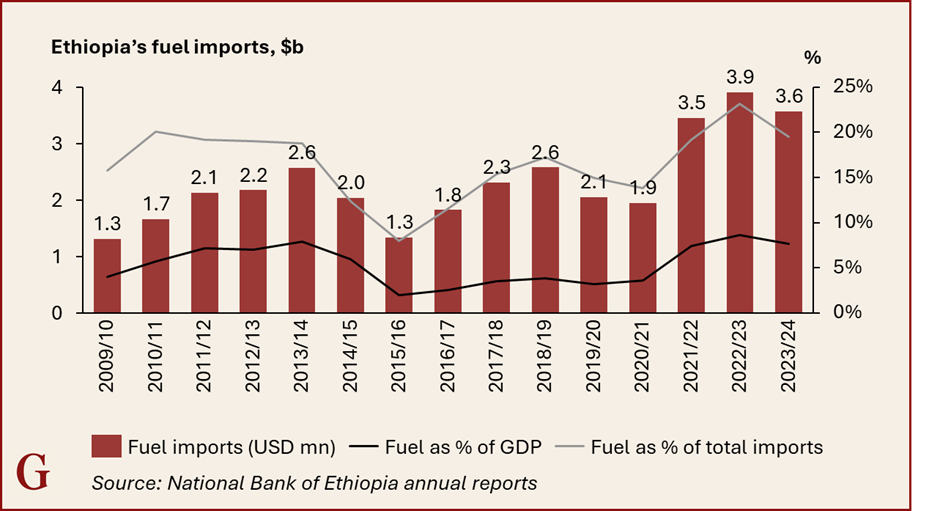
As a country without oil, vehicle restrictions were a way of managing fuel imports and their impact on foreign exchange. Ethiopia decided to overvalue its currency, making imports cheaper but requiring government-mandated exchange rates and capital controls. Black market providers converted massive wads of Ethiopian birr into dollars at more competitive rates, because the government so heavily restricted access to hard currency. Even after high tariffs depressed Ethiopian car ownership to one of the lowest rates in the world – 13 per 1,000 people [1] – Ethiopia still spent over $3 billion of foreign currency on petroleum imports each year from 2022 to 2024. This was around 8% of GDP and over 20% of its imports.
Ethiopian annual fuel imports in $b (LHS) and as % of GDP and % of imports (RHS)
The foreign exchange shortage eventually became untenable. From 2016 to now, the Ethiopian birr has lost ~86% of its value. The government managed a gradual devaluation of its currency until it finally defaulted on foreign debt in 2023 and began an IMF restructuring programme including a currency float in 2024.
Against this backdrop, Ethiopia’s revised car import policies are best understood as supporting currency stability and energy security. Ethiopia led the world in banning internal combustion engine (ICE) vehicle imports and practically eliminating import tariffs on Electric Vehicles (EVs) [2]. Ethiopia’s state minister for transport and logistics confirmed to Bloomberg that this wasn’t necessarily about the climate: “our transition to EVs is aimed at ensuring our energy sovereignty.”
While Ethiopia lacks domestic fossil fuels, it has abundant local, clean generation capacity. The 5.15 gigawatt [3] Grand Ethiopian Renaissance Dam, which I partially funded in an office raffle, was recently completed at great financial and geopolitical expense. By promoting EVs and banning ICE vehicles, Ethiopia can switch its energy demand from imported fossil fuels to domestic electricity generation and provide offtake for the dam [4]. Electricity demand growth is helpful when East Africa seems to have excess generation capacity [5]. While dams have their own risks (e.g. physical concentration, drought, conflict), this move will limit Ethiopia’s reliance on foreign trade routes, reduce price volatility, and improve the country’s balance of payments.
China has been doing this for years
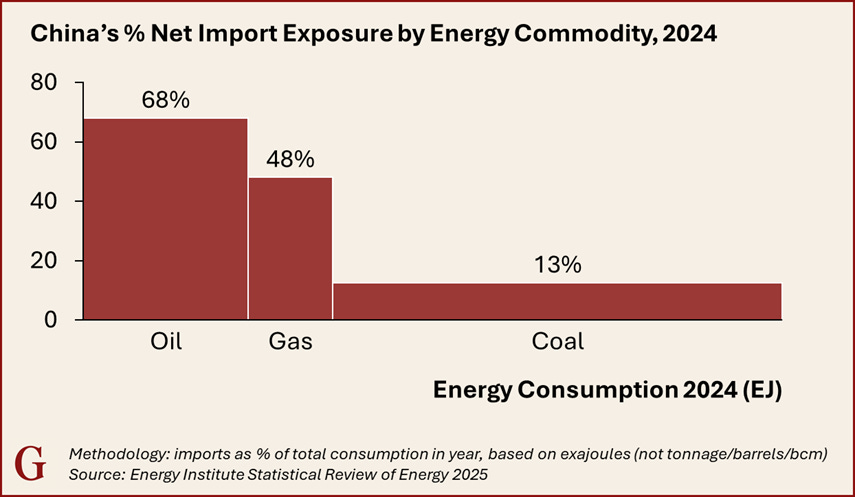
Energy security is also a major driver for why China has invested so heavily in its renewable and electrification supply chains. Climate feels secondary, not least because coal is such a large part of China’s energy system. China produces and consumes more than half of the world’s coal, and just 13% of its coal consumption is imported. In contrast, 68% of oil and 48% of gas demand is met by imports [6]. Coal still supplies ~58% of the electricity demand [7], though its share is declining due to increasing renewable and nuclear installations.
Chinese energy consumption import exposure by commodity, 2024
Electrification helps drive more energy demand to domestic fuel sources. EVs and transport electrification displace imported oil, while electric heating or heat waste from coal plants can displace gas demand. Import substitution with coal is growing beyond the electricity system, by converting it into chemicals that typically use oil and gas as a feedstock. This supports domestic industry and geopolitical independence but is a more carbon intensive process.
Ethiopia and China’s approach to energy security offers two insights for the UK and Europe.
Electrification helps most when electricity generation is secure too
Calling for electrification alone will not help as much with our energy security unless generation is also ‘secure’. Electrified demand can improve grid reliability, making the system more dynamic and manageable if paired with demand response and smart devices. Distributed batteries in EVs and households will one day help to weather storms and deal with days-long outages if necessary. However, if all vehicles were electric and all households used heat pumps, the UK electricity grid would still be heavily exposed to commodity shocks.
UK electricity supply by import and fossil fuel exposure, 1998-2024
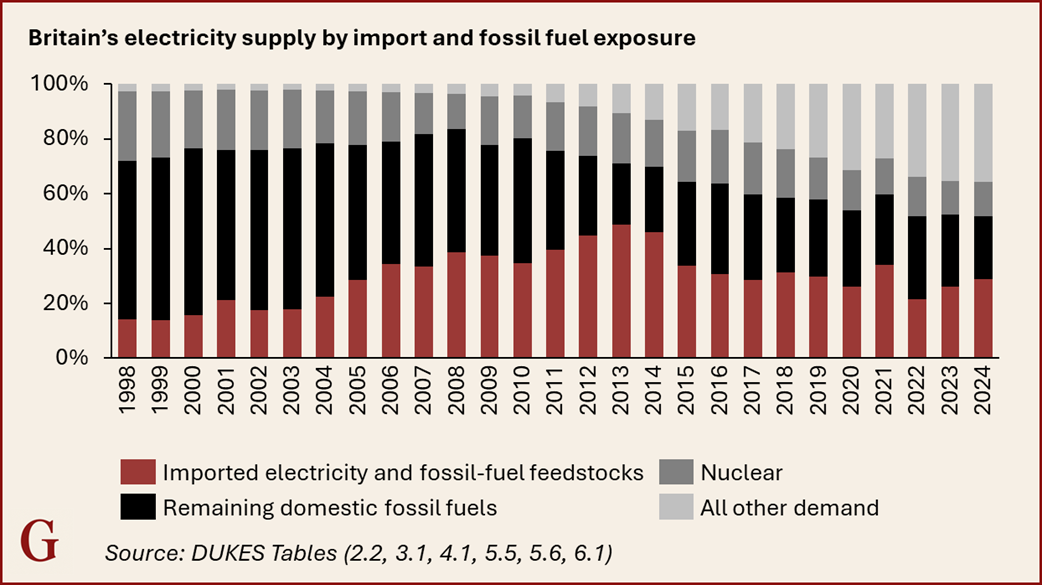
As of 2024, 29% of British electricity relied on imports [8], and a further 23% was linked to fossil fuel commodity prices. In 1998, 72% of the grid relied on fossil fuels, but just 14% electricity supply was imported. Household electricity prices in Britain have risen more than four-fold since 1998, while average consumer prices doubled. Imports and fossil fuels have both fallen as a share of the electricity mix over the past decade, but the globally traded gas price is still a major driver of our energy cost increases. Relying on imports and fossil fuels poses physical availability risk, along with price volatility. More domestic energy supply from renewable and fossil fuel sources has helped other countries reap more benefit from electrifying demand.
The risk of relying on another country’s manufactured products has helped to slow renewable installations in Europe and the US, but this risk is different from relying on commodity imports. Even if countries import solar panels or wind turbines, once these assets are in the ground they can be used for decades. Fossil fuel supply disruptions make waves within days or weeks, even when countries have months’ worth of supply in emergency stockpiles. A disruption to manufacturing supply chains would certainly impact energy investment and growth of renewables but it would not cut off existing resources from generating. Deindustrialisation is a real problem for long-term security and jobs, but this fear in the short term has slowed the deployment of cheap renewables that could have helped bring down energy costs and preserve industrial competitiveness.
Electrification is not always green
Pairing local production with electrification will not always be a positive climate outcome if domestic resources are carbon intensive. Electrification in China and India has enabled domestic coal to contribute more to the energy mix, while Ethiopia’s transport electrification enables using abundant hydroelectric resources. Switching from petrol to coal-based electricity can still be an emissions savings for cars, but only if they are used for long enough. In war, coal is a substitute for gas and is easier to store and stockpile. Its international price has risen alongside oil and gas over the past 12 days as electricity generators substitute for a cheaper or more readily available feedstock. Coal is almost twice as carbon intensive per unit of electricity generated [9], and worse still for health impacts. It isn’t always cheap, especially after including these externalities, but it is perceived as more dependable than solar and batteries.
Pairing electrification with renewables and domestic fossil fuel generation as an energy security strategy is not novel. China has been laying the ground for this for a decade or more, and many parts of the world have followed. The Ukraine War should have been a wake-up call to drive more electrification and alternative energy development in nations with high import dependency, especially in the UK and Europe.
Instead, we are in a “déjà vu moment” of scrambling to deal with a cost-of-living crisis, after a net zero backlash that has seen some nations pull back on renewable energy growth. We have resisted, partly because of perceived negative impacts like cost, job losses or supply chain dependence on nations they don’t trust. Yet every time there is a fossil fuel supply crisis, these arguments feel insufficient in the face of inflationary shocks. We’ve been taught this many times before, but we aren’t learning the lesson fast enough.
Energy markets aren’t necessarily designed for energy security, perhaps because consumers don’t realise how much they value price stability until a crisis. This is the most expensive time to pay for it. If voters want energy security, the government needs to help bridge the market and perception gap for how much this will cost in the good times. They also need to communicate that clean energy is capable of providing it cost-effectively, and that its exposure to supply chain disruptions is in the order of months or years, not days and weeks.
Renewables and electrification together should be the answer for Europe’s energy security, and possibly even developing local fossil fuel resources and storage if this is cost-effective. Electrification without also investing in local generation will otherwise not be enough for us to be resilient.
Subscribing is free - join 800+ followers in 48+ countries to receive weekly long-reads on the energy transition. If my work resonated (positively or negatively), share it with friends and colleagues, like it or repost it, and let me know what you think in the comments.
[1] In the US and Britain, this figure is 874 (population of ~340 million) and 602 (population of ~69 million) respectively.
[2] They are between 0 to 15%, which is not nothing, but is much lower than 200%.
[3] Average load of 1.8 gigawatts.
[4] [Check Dan Mark’s point about how this dam isn’t supposed to be run at 100%].
[5] This is my judgment based on current energy consumption per capita, connection rates, affordability, and energy demand growth. East Africa would lack enough supply if everyone had electricity access and used as much energy as higher income countries.
[6] Using Energy Institute Statistical Review of World Energy 2025. Data is for 2024, based on exajoules rather than mass or volumetric measures. Import dependency is even lower for coal on a tonnage basis because imported coal has higher calorie content.
[8] See chart. This is calculated using interconnector net imports and the upstream import exposure of coal, gas, oil, and biomass electricity supply. Nuclear is broken out separately in the charts because it is also imported but not a fossil fuel and with different supply chain risks.
[9] Coal power emits around double the per-kWh carbon dioxide as gas.
Korea is the stress test for this thesis. No domestic fossil fuels, nearly 100% LNG import dependency for gas-fired generation, and LNG sets the wholesale electricity price over 80% of the time. Electrifying heating or transport doesn’t reduce import exposure — it just shifts it from the gas meter to the power bill. The only domestic generation fuel Korea has at scale is nuclear, which is why the current government is pushing both nuclear expansion and renewables simultaneously. Electrification without domestic generation is just a different import dependency.
This is a perspective that often gets lost in the ESG conversation. Electrification isn’t just a climate strategy — it’s increasingly a security strategy.
Countries that reduce dependence on imported fuels aren’t only lowering emissions; they’re also reducing geopolitical vulnerability.
The interesting question going forward might be whether markets will start pricing energy independence as a strategic asset — not just an environmental one.