
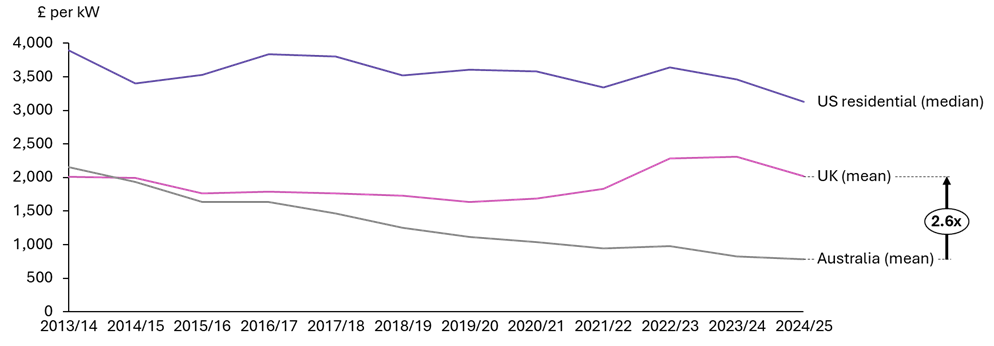
In a rare moment of parental bonding over energy economics, my mum and I both got quotes for rooftop solar this week. Installing ~9 kilowatts of solar on her bungalow in Queensland, Australia, costs £6,324, or £710 per kilowatt[1]. To get ~13 kilowatts onto my apartment building in London costs 33% more per kilowatt[2]. The UK’s national average prices were even worse in FY2025, at 2.6 times Australia’s installation costs. Both countries import solar panels from abroad and Australia’s wages are higher. So what’s driving prices in the UK and what can we do about it?
Rooftop solar installation cost per kW by year, UK vs Australia and US (with comparability caveats)
The UK’s physical differences
Expensive rooftop solar is not unique to Britain. US rooftop solar costs are even higher. David Roberts’ Volts podcast explored the US’s “paperwork” problem, among other differences between Australia’s solar market. As bureaucratic as the UK’s energy system is, this is only part of the story driving the UK’s high rooftop solar costs.
The weather is the most obvious difference between the UK and other solar markets. Our skies are particularly cloudy, and daylight hours change dramatically between winter and summer. The average capacity factor for solar, a measure of utilisation, is just 10% to 12% in Britain[3] compared to 21% worldwide and higher in sunnier locations like Australia and California. The volume of rooftop installations is much larger in Australia at 28 gigawatts of installed capacity as of 2025, versus the UK’s 8 gigawatts, which reduces procurement cost from scale. Installers also have more volume in their local area, meaning they can cluster visits to homes closer together. Despite its low efficiency, solar is still cheaper than British retail and wholesale electricity[4], but the payback period is longer and uptake is lower.
The UK’s housing stock, too, impacts system sizes. 9% of homes in England and Wales are bungalows, and a further 66% are multi-storey houses, of which less than a quarter are fully detached[5]. 38% of American housing stock is single-storey of which 95% is detached. 70% of Australia’s housing stock is detached and anecdotal evidence suggests that more of Australia’s homes are single-storey, but there is no consistent statistical evidence to support this claim[6].
Regardless, Britain fits more people into less space[7], which combined with multi-storey housing decreases the rooftop area for systems. The average UK rooftop solar system was just 4.5 kilowatts in 2025 according to MCS, compared with 9.9 kilowatts in Australia[8] and ~7 kilowatts in the US[9]. This reduces economies of scale from each installation, as fixed costs are spread over fewer kilowatts.
Average rooftop solar installation size by year, UK vs Australia and US (with comparability caveats)

The UK’s housing stock also affects installation techniques. UK roofs can be more difficult to access because the housing stock is older, buildings are higher and homes are often connected to other properties. The UK uses scaffolds as a standard safety measure for installations while Australia relies more on harnesses and roof edge protections. Scaffolds can cause delays in getting an installation date, and increase costs per kilowatt for smaller system sizes because scaffolding incurs fixed costs.
“Soft cost” differences
Australia’s real strength is managing “soft costs”. Australia’s process from inquiry to installation is ultra-fast with significant automation. This reduces the customer acquisition cost by bringing down attrition. My mum had a technician onsite to run the assessment within a week, and could get the installation done just as quickly if she could make up her mind about whether she wants proceed. Planning approval is automatic, as is the grid upgrade request. Inspections that slow down installations are kept to a minimum in Australia, instead relying on technician training and spot-checks for quality and safety compliance.
The UK’s procurement, planning, and interconnection processes are navigable, but not as seamless. Price comparison websites don’t actually offer much of a choice between installers. I was only shown two in Kensington on the UK’s largest website, and one has yet to follow up. Planning approval is automatic, unless you live in a conservation area, and although my borough has waived most listed building consents for solar, Kensington still has one of the lowest rooftop solar installation rates in the country[10]. Scaffolding is a constraint to building, and a site inspection is required before works can continue. The distribution connection to export power to the grid is not automatic for systems above a certain size (usually 3.68 kilowatts[11]). This all adds uncertainty and time to the installation.
How Britain can bring down rooftop solar costs
Rather than accept that Britain’s build costs are structurally higher, the government and industry associations can play a role in bringing them down by unlocking the benefit of scale.
1) Incentivise coordination with neighbours
Despite the UK’s small rooftops, its population density is an asset. Based on my conversations with a solar installer network[12], bundling initial site assessment visits on a street can bring down the assessment cost by ~£250 by reducing the number of call-outs and transport time. Coordinating with neighbours to install systems can decrease costs by a further £300 to £400 per customer by reducing scaffolding set-up time, installation and travel time. When the average system cost is currently over £7,000[13], this could represent material savings per job. It also improves community buy-in for solar projects and reduces street disruption from installations.
Programs like Switch Together[14] facilitate coordination and procurement savings but have supported ~3% of UK households with solar to date[15]. New grant programs should incentivise neighbourhood cooperation and planning to allow government spending to cover more installations.
2) Help small businesses procure in bulk
The government or industry bodies could also support bulk procurement by launching a dedicated buying aggregation platform for smaller installers and potentially covering the group under a guarantee. In Africa, small off-grid solar suppliers coordinated via their industry association to procure equipment in bulk, securing a 24% discount on solar PV. The UK’s fragmented installer network could benefit from economies of scale, while allowing them to remain local and independent operators.
3) Roll out rooftop PV to more government buildings including councils
In addition, the government could drive volume through mandatory installations on state-owned properties. This could expand on Great British Energy’s work supporting solar PV on schools, NHS buildings and military sites to include other departments like Transport and the Home Office, and council-owned properties. Third-party financing could support these installations for capital-constrained councils, or investments from pension funds.
4) Review installation practices and DNO connection rules
Beyond scale, the UK could also review its solar installation practices. Scaffolding for safety purposes is a major driver of cost and scheduling friction. Australian installations typically use roof edge protection and harnesses to work from height without erecting a full scaffold. This may not be appropriate for the UK but is worth a review if the safety outcomes are similar. Offering guaranteed and automatic connections for larger system sizes to export to the distribution network would also remove a friction at the end of commissioning.
5) Develop revenue-share products so landlords can benefit alongside renters
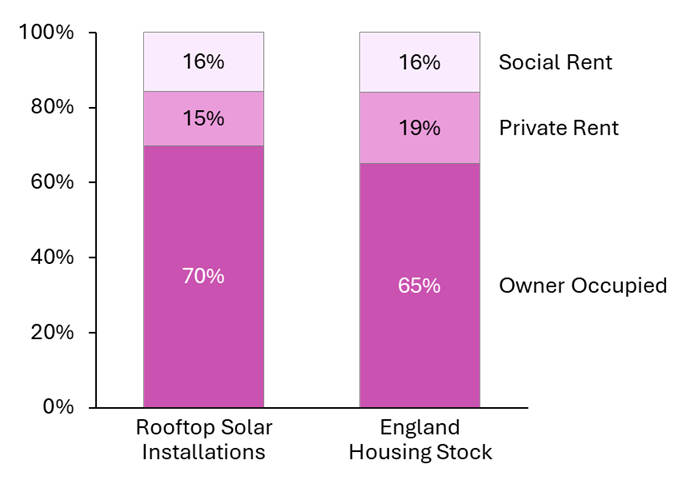
Novel financing mechanisms with landlords could drive further adoption among private renters, particularly in London. Owner-occupied dwellings are unsurprisingly over-represented as they have the power to make upgrades to their home and benefit from energy bill reductions. If I wanted to pitch rooftop solar to my landlord to save money on my energy bill, I could offer them a small share of my bill savings, and they would retain this asset for future tenants. Energy suppliers could offer this explicit split-revenue product to allow both renters and landlords to benefit from cheaper electricity.
Installations and Housing Stock by Tenure, latest available
6) Pair solar with batteries
Batteries are increasingly cost effective, and could help the distribution network to manage the cost of upgrades to homes, reducing the need for grid export capabilities. Enabling real-time prices would allow customers to benefit from electricity trading on wholesale markets to generate income. Batteries would also increase system resilience during extreme weather events and outages, potentially bringing down system costs. This trend has already started, with tens of thousands of battery installations alongside solar as of 2025.
Britain’s high energy bills have made rooftop solar a surprising success. Even at current installation costs, my quoted system would break even after nine years. But there is certainly room for cost improvement through increasing scale and reducing other frictions, without necessarily impacting the quality of the system or its installation. As the government fleshes out its Warm Homes and Local Power Plans, it could make grant money go further. By paying attention to reducing installation costs for rooftop solar, more people around the UK could benefit from cheaper energy.
This is part of a series on UK energy policy. Other ideas include repurposing coal assets and small ways to make cumulatively big cuts to energy bills.
Join 600+ readers in 46 countries who subscribe to my column to receive weekly analysis on the energy transition and occasional news summaries. Share with friends and colleagues, and leave a comment on whether you think the UK can feasibly reduce its rooftop solar costs.
[1] A$9,718 for a Solahart 8.9 kW system and 9.9 kW inverter. Quoted after a 45-minute site survey. Quote includes government rebate of A$2,480 for 9kW solar systems.
[2] £12,276 for a 12.96 kW system, quoted using an online estimation tool of my roof size. I am a tenant in an apartment building, so need to approach the landlord with this pitch if I wanted to get rooftop solar installed.
[3] Depending on sources (DESNZ actuals vs Arup estimates).
[4] Recent AR7a results show solar beating offshore wind, onshore wind and wholesale prices based on unit electricity costs – wholesale prices were ~£85/MWh (volume-weighted) in 2025. Retail prices are ~£350/MWh as of the Q1 2026 price cap.
[5] Council Tax records, 2024. The remainder are apartments/flats.
[6] 2021 census, no storeys are provided.
[7] 287.5 people per square kilometre in the UK, versus 38 in the US and 3.5 in Australia. However, vaste swathes of the US and Australia are uninhabited, including lots of desert. UK homes tend to be smaller than American and Australian homes by floorspace, and may be situated across more storeys, reducing rooftop space.
[8] Admittedly, the comparison is not like-for-like – Australian averages include systems up to 100kW, while Britain’s includes only up to 50kW systems and the highest and lowest 5% of installation costs are excluded from MCS analysis. However, systems 40kW+ make up just 2% of Australia’s installations so are unlikely to skew the results significantly.
[9] 2024 figure, median, residential only.
[10] Partially due to a higher share of people living in flats than the national average.
[11] If a home has a 16A connection and the solar installation won’t exceed that, it can ‘connect then notify’. If the solar installation exceeds this, or the property already has other load e.g. an EV charger, it must apply for a connection. For single-phase connection homes, this equates to a limit of 3.68kW of generation capacity to export to the grid before approvals are required. More here.
[12] Kevin Holland, CEO of Solar Nation, plus several installers who offered smaller anecdotes.
[13] Data as of 2026 - £7,384 average installation cost. Cost per kW is £1,582, implying average system size of 4.7kW in 2026. This data excludes extreme cost profiles (top and bottom 5%) so is not a true average.
[14] Formerly Solar Together.
[15] ~40,000 households supported as of 15th Feb 2026, and at least 1.5 million homes with solar.
I wonder if coupling neighbourhood coordination with BESS co-location could encourage landlords to modify their rental’s energy systems. Assuming you can balance lower upfront costs with a large enough revenue-share upside.
Interesting article Lucy. I have been investigating and have had quotes for 10kw, 9kwh battery and inverter from around £11k for one of the more premium batteries. There was quite a lot of variation in the quotes. I am assuming there is probably quite a lot of London premium in the price you were quoted (I'm in the Midlands).
Agree re the time / complexity to get grid approval grid - but I believe the main challenge is the lack of capacity on a lot of the local grids and the potential over voltage if too much connects. I saw online they they are consulting about moving standard voltages down slightly to help get more on the grid without requiring reinforcement (apparently we nominally moved from 240v to 230v to align with Europe to make electronics cheaper, but havent necessarily changed the actual voltage)
I am currently 4 weeks into waiting for my G99 (application for over 3.68kw) - and it could be another 4 weeks before I hear. I can't see the wait times reducing as more people connect and the grid gets more congested unless they are forced to invest in growing the teams by OFGEM. To get this they required a detailed wiring diagram - not sure why it cant just be that they tell you what export limit you can have and mandate you have to have a MCS installer?
Hopefully Balcony Solar will be approved in the UK shortly which could be an opportunity (though a lot smaller scale) for you without needing landlord approval.